Sister blog of Physicists of the Caribbean. Shorter, more focused posts specialising in astronomy and data visualisation.

Tuesday, 25 August 2020

A Bridge Quite Far

Specifically, a bridge between two galaxy clusters that spans a whopping 2 Mpc. They'd seen some earlier hints of this in previous data, but now have higher sensitivity from multiple telescopes to try and confirm it. And it's rock solid at 144 MHz and (in my opinion - they're more cautious) 53 MHz, but tentative at best at 383 MHz and not visible at all at 1.5 GHz.

Such bridges are rare in the extreme - this is one of only two such features known, making them hard to understand. You can't, for example, say what types of system most commonly host them, so it's difficult to comment on their origins. Even the emission mechanism is uncertain, since it's only clearly detected at one frequency. They say :
According to Brunetti & Vazza (2020), radio bridges may originate from second-order Fermi acceleration of electrons interacting with turbulent motions triggered by the complex dynamics in the overdense region between premerging clusters.
Basically it's from very low energy, low density, ionised gas. Interestingly there's a correlation with the much hotter X-ray emission, pointing to a connection between thermal and non-thermal sources, but that's about all they can say from this.

The larger question of whether this gas is primordial, i.e. we're seeing the cosmic web itself, or non-primordial gas from interactions, isn't addressed directly. And fair enough really - when you've discovered a bridge of gas 2 Mpc in length, you're absolutely entitled to write a short letter than says little more besides, "we found a bridge of gas 2 Mpc in length". Interestingly though, both cases of giant radio bridges (or in one slightly amusing typo, radio brides) are found in massive, pre-merging clusters that themselves consist of interacting sub-structures. So I guess both options are open, though presumably the sheer length of the thing would more naturally suggest a primordial structure. But until more of these are found, there's little else to be said apart from, "hey, that's neat !".

A giant radio bridge connecting two clusters in Abell 1758

Collisions between galaxy clusters dissipate enormous amounts of energy in the intra-cluster medium (ICM) through turbulence and shocks. In the process, Mpc-scale diffuse synchrotron emission in form of radio halos and relics can form. However, little is known about the very early phase of the collision.

Thursday, 23 July 2020

The Virgo Cluster is feeling left out

Ultra diffuse galaxies were once thought to be oddly rare in the Virgo cluster. This was very disappointing since all the other clusters seem to be full of the damn things. What's wrong with poor old Virgo ? Is it too violent for them to survive ? Unlikely, since it's got hundreds of more generic low surface brightness galaxies. Is Virgo the extragalactic equivalent of the angry neighbour no-one wants to meet because they don't know about deodorant ?

Probably not. As previously suggested, it could all be due to the way the data was processed. Over such a large area as Virgo, few are brave enough to attempt a search by eye, and automatic algorithms are very sensitive to their input parameters. Typically they return initial catalogues of the order of millions of objects, which have to be carefully culled down to a few hundred or thousand objects that can be examined the old-fashioned way. And even slight differences in the way the data was processed, which might not make any difference at all to the brighter galaxies, can cause big changes in how many UDG candidates pop out.

This paper searches the previously UDG-free data from the Next Generation Virgo Survey (the most sensitive large-scale optical survey of the cluster to date) and produces a catalogue of up to 70 objects. Oddly, they don't mention any special data processing, so why previous searches of this same data set have come up empty (if I recall correctly, only three UDGs were hitherto known in Virgo) is anyone's guess.

The broad definition of a UDG, which became widely accepted very quickly, is that it's large and faint. These two parameters are relatively easy to measure (but see this) but the authors decide they need a better definition since there isn't a good physical motivation for the conventional criteria. So, annoyingly, they come up with a more physical but far more complex selection criterion that a UDG is anything which deviates by more than two sigma from no less than three non-linear scaling relations. Yikes.

This isn't as mad as it sounds. As clear from their plot, the conventional definition would miss quite a lot of really interesting objects - specifically the largest ones. But it's awkward, and it doesn't help that their plot has an extremely strange vertical stretch. I don't see this catching on, and for smaller objects it doesn't appear to make much difference anyway.

One point that's probably worth mentioning, though, is that choosing objects which are in the tail-end of a distribution does not necessarily mean that those objects are simply more extreme versions of the general population : that would be a statistical bias. It's possible to populate parameter space with objects that form by very different mechanisms, so that the distribution is continuous isn't evidence in itself that the objects are all part of the same population.

Most of the rest of the paper is a tedious slog-through all the possible analysis using rather small number statistics. Great for the enthusiast, no doubt, but not exactly thrilling bedtime reading. Also their thumbnail images (figure 6), while very nice, look extremely red, which seems just a bit odd.

They find two quite interesting things. First, the core of the cluster has more UDGs than elsewhere, in contradiction to other surveys which find that UDGs are not clustered. How this compares with the overall galaxy density they don't say, so I wonder how big a deal this really is. And is it telling us something about the nature of the UDGs or their environment ? The statistics are just too small to say anything. Second, all the globular clusters of the UDGs are redder than globular clusters around non-UDGs of the same stellar mass. Why that should be is anyone's guess.

Overall, they conclude as others have that UDGs likely form by a variety of mechanisms. They seem to occupy the tails of various distributions, suggesting they're normal but extremely faint galaxies. There really doesn't seem to be anything much at all to distinguish them from other galaxies except that they're faint for their size. Potentially this is extremely interesting, but without proper dynamical measurements the key feature - how much dark matter they have - will have to wait. Some of them are definitely tidally interacting, so it's possible that this is part of their formation mechanism in at least some cases, but it seems they don't think this is likely to explain the majority.

In short, Virgo does have UDGs after all, but how they form remains pretty much as mysterious as ever.

The Next Generation Virgo Cluster Survey (NGVS). XXX. Ultra-Diffuse Galaxies and their Globular Cluster Systems

We present a study of ultra-diffuse galaxies (UDGs) in the Virgo Cluster based on deep imaging from the Next Generation Virgo Cluster Survey (NGVS). Applying a new definition for the UDG class based on galaxy scaling relations, we define samples of 44 and 26 UDGs using expansive and restrictive selection criteria, respectively.

Monday, 20 July 2020

A jellyfish running out of gas

 A "jellyfish" galaxy is one which has long tails of ionised gas. The term is a bit liberal, but mainly of them have very thin, tendril-like structures, sometimes much larger than the main stellar disc, so they do often look quite a lot like jellyfish.

But ionised gas is rubbish and everyone hates it, so what about the much more sexy neutral gas ? This nice little paper presents some VLA observations of a jellyfish galaxy in a nearby-ish cluster, which they then compare with an arbitrary other galaxy in some other cluster. To be honest, I didn't find that aspect of the paper at all useful. It's a bit like picking one jellyfish out of the Atlantic ocean and comparing it with another picked at random out of the Pacific : you can't really learn anything by such a comparison. It's not the author's fault, mind - it's hard to get neutral gas observations at this distance, so the current sample size is very small.

The other bit I don't like is the claim that this jellyfish has only a short (40 kpc) tail of HI, compared to the ionised gas which extends ~100 kpc. Given the poor sensitivity of the VLA in C-configuration, I don't think this means anything much except that the density of the gas at the larger distances must be lower.

What is quite interesting is that the star formation activity seems to be somewhat enhanced compared to non-jellyfish galaxies. This particular object is almost certainly the result of ram pressure stripping as the galaxy ploughs through the hot, thin intracluster medium. While this ultimately drains all the galaxy's gas and prevents star formation, in the initial stages it can compress the gas and so give the galaxy a final burst before its untimely death.

But that's not terribly surprising. The most interesting thing to me is that while the HI doesn't seem to be at all spatially displaced from its parent galaxy, or marginally so (its "tail" being a slightly lopsided and ragged edge on one side), its kinematics are quite different. The systemic velocity of the gas and stars differs by ~100-200 km/s. This isn't seen in similar cases in the  much closer Virgo cluster : stripping galaxies there have clear tails but with gas discs that are relatively unperturbed. Perhaps this is a case of particularly strong stripping, or maybe most of the motion is along the line of sight. It'd be nice to get much deeper observations of objects like this, but that will probably have to wait for future instruments.


EDIT : Hot on the heels of this gassy-tailed jellyfish comes another paper about a similar object with higher-resolution data. This is an especially fun object : it has strong stellar tails indicating a tidal interaction with a nearby galaxy, with most of its gas being displaced in both space (only slightly, but very clearly) and velocity (by ~340 km/s). Since the gas morphology does not well-match the stellar morphology, the authors attribute this to ram pressure occuring along the line of sight. Unlike the other object, there's no evidence that this has increased the star formation rate, even though the surface density of the gas is higher outside the stellar disc. They say it might be stretched, so its volume density remains low despite the higher surface density. A very nice object indeed !

GASP XXVI. HI Gas in Jellyfish Galaxies: The case of JO201 and JO206

We present HI observations of the jellyfish galaxy, JO201. This massive galaxy (M$_{\ast} = 3.5 \times 10^{10}$ M$_\odot$) is falling along the line-of-sight towards the centre of a rich cluster (M$_{200} \sim 1.6 \times 10^{15}$ M$_\odot$, $σ_{cl} \sim 982$ km/s) at a high velocity $\geq$3363 km/s.

Tuesday, 7 July 2020

A long time to say "I told you so"

Back in 1997, Raul Jimenez predicted that some galaxies could be completely optically dark, or nearly so. Such a "dark galaxy" would be a big disc of hydrogen spinning serenely inside a dark matter halo, but with such a low density that star formation was at worst an occasional irritation, and at best averted completely, rather than the more typical state of galaxies as star formation factories that are good for only one thing. Here, with the assistance of some delightful nominative determinism of Alan Heavens, he revisits his predictions.

I can't claim to fully understand the details of modelling, but the gist of it is simple enough. Atomic hydrogen needs to reach a certain density before its self-gravity reaches the point where it overwhelms any other counteracting forces and collapses into stars. One such counteracting force is the thermal temperature of the gas, generally around 10,000 K, equivalent to random motions of 10 km/s. Another is the spin, which keeps the gas on stable circular orbits, and this can be much larger - up to ~500 km/s in extreme cases. The "spin parameter" is a measure of how much of a role the rotation plays in preventing collapse. It's a bit more complicated than ordinary rotation, but the two are roughly equivalent : the faster the rotation, the harder it will be for gas to collapse and form stars.

Twenty-three years ago, Jimenez predicted the value of the spin parameter above which galaxies ought to remain entirely dark. Back then detecting the gas of such galaxies was a formidable challenge indeed, but two decades of improvements have allowed his predictions to be tested. In particular, the gas-rich "Ultra Diffuse Galaxies" from the ALFALFA survey are natural targets for comparison : they have a few stars, but far less than typical galaxies of comparable size.

Jimenez finds that these UDGs are indeed well-described by the high-spin tail model, where the most extreme spin-dominated galaxies remain optically dark in the conventional cold dark matter scenario. The number of discoveries (22) is in excellent agreement with the prediction (24). They're also in good quantitative agreement for his prediction of just how bright - allowing "dark" to be a synonym for "very dim" - they should be and what colours they should have. He says that ALFALFA has probably detected nearly all the largest dark halos and that only a survey of an even larger volume would detect any more. In contrast, detecting less massive galaxies requires a more sensitive survey.

What does this mean for my beloved clouds in the much deeper AGES survey ? I'm not sure yet, but the spin parameter would be interesting to compare. Those clouds are totally optically dark, but one of the main doubts about their galaxian nature is that we only found them in the Virgo cluster... on the other hand, Virgo is uniquely dense so this would be the best place to detect rare objects.

Even more interesting would be what this means for the very smallest objects, i.e. the missing satellite problem that prompted the whole "dark galaxy" thing in the first place. Jimenez doesn't describe this, or the other predictions of dark galaxies that were in vogue at the time. Still, this is potentially a super-interesting result. My main question is : what about all those other UDGs that don't have gas ? How do they fit into the model, and why don't more of them have gas ? But after twenty years, this is probably interesting enough already.

The distribution of dark galaxies and spin bias

In the light of the discovery of numerous (almost) dark galaxies from the ALFALAFA and LITTLE THINGS surveys, we revisit the predictions of Jimenez et al. 1997, based on the Toomre stability of rapidly-spinning gas disks. We have updated the predictions for $Λ$CDM with parameters given by Planck18, computing the expected number densities of dark objects, and their spin parameter and mass distributions.

Monday, 6 July 2020

Living in a virtual world (but I am not a virtual girl)

Last week I did exactly two things : I attended my first online conference, the EAS 2020 "in Leiden", and I spent every spare minute playing with my long-awaited Oculus Quest. More on that elsewhere. Here, let me say something about the wonders of attending a conference from one's own home.

Back in my day, online talks were a thing to quaken the hearts of the bravest of men. They were sorry and desperate affairs that were as much use as listening to the London Underground tannoy for a solid hour : totally inaudible and we'd all have been better off spending the time silently contemplating the Oneness Of All Things. Not so in the modern era, where the pandemic has made a necessity of achieving something which was already well within technological capacity.

There are, of course, both advantages and disadvantages to online conferences. On the positive sides, there's no need to travel, talks are stored online (sensibly only for a month, meaning I might actually muster the energy to look at talks I missed : if they were there indefinitely then I never would), and it's far easier to drop in and out of different sessions. On the downsides, there's no opportunity to travel, you have no sense of the audience response, there's no social aspect (they did try, but after spending so much time listening to a screen, I found it necessary to spend the break times not staring at a screen, at least not one filled with science), and it seemed to me that people were lessing willing to raise controversial topics.

Overall, the positives have the advantage. In the future I think it would be extremely strange for any conference not to move to at least a hybrid system - the convenience is too great. At the same time, it would be a loss if physical attendance became unusual - the social aspect of presence is important (and one of the perks you get for accepting an astronomer's meagre salary is an astronomer's not-so-meagre travel privileges, but I'd be happy if they converted this to salary instead !). Through body language and the more free-flowing discussion that happens in tea time, it's easier to say, "I disagree" in person without sounding like a jerk. Which is a bit strange, because plenty of people still manage to say, "I disagree" while sounding exactly like a jerk, and it ought to be easier to avoid this in an online system.


As for this specific conference, everything went almost without a hitch. Things got off to a rocky start though, when the first speaker in the first talk I went to turned out to be actually painfully dull to listen to. If he'd been on Just A Minute he'd have been out in seconds. He talked so incredibly slowly that you'd forget the start of the sentence by the time he finished, thus meaning he conveyed no information whatsoever - no, really, absolutely nothing - besides what a poor choice someone made in inviting him to give a presentation.

Although almost entirely humour-free, there were however a couple of amusing points. One speaker stood up, earning praise from the chair for making it more lively, so the next speaker said they weren't going to stand up on the grounds they were still in pyjamas. Then there was a faux pas a chair was clearly unaware of, saying, "unfortunately we have to move on to the next speaker", which I thought sounded pretty bad for the next speaker !

This raises my only serious niggle : the tendency for several people to have multiple talks in different sessions. I do find this really unfair and annoying. By all means, give as many posters as you like, but if you get to speak for 45 minutes because your research is famous and I only get a 1.5 minute poster presentation, that needlessly exacerbates inequality. There needs to be more coordination between sessions to ensure that no speaker gives the same talk twice, and has a maximum of two talks. Otherwise, lesser-known researchers get hidden in the virtual-but-not-entirely-metaphorical poster basement.

I don't know if anyone else did this or it was just me, but I didn't feel particularly inclined to check out any other posters. In a real conference, you can combine wandering around the poster room with a nice cuppa, allowing you to at least partly switch off during the tea breaks. For me, not listening to science for 30 minutes and being able to browse the pretty pictures is important to maintain sanity. I might eventually get around to it, but I felt no pressing need to do so here.

But all of these are quibbles. Overall, it was a great conference with some really interesting talks and truly exceptionally high-quality timekeeping, even if it didn't have enough jokes. So, on to the science !


It's not bug, it's a feature

First off were an interesting pair of talks. Frederico Lelli - he of the MDAR - claimed that the baryonic Tully-Fisher relation is consistent and has low scatter across a wide range of masses, whereas Pavel Pina - he of the UDGs - claimed that there's good evidence that some galaxies don't obey the BTFR at all. Or to put it another way, either all galaxies have similar dynamics that can be predicted entirely from their baryonic matter (which would be weird if they're all dominated by dark matter) or only some can. It's all very confusing and definitely not settled.

Although I'm firmly in the "dark matter is definitely a thing" camp, both had some interesting points. Lelli notes (of course) that there's a break in the stellas mass TFR, but that goes away if you add in the gas. He also shows that the tight relation is only seen with the highest quality data, and you have to have rotation curves which extend sufficiently far as to reach the flat bit. I'm in two minds about that. On the one hand, I can see why you'd do it, but on the other, how do we know the flat bit indicates stability or that the baryons are sufficiently extended ? Has anyone looked for baryon configurations that could give stable results without flat rotation curves ? Otherwise selecting only the flat curves is a potential bias that means you'll never find any deviants. Maybe.

Pina's Ultra Diffuse Galaxies show strong, weird deviations from the baryonic TFR and now he adds a few more that are intermediate. I wasn't sure if the data was really good enough to give the accurate velocity widths needed, and as I've noted here before, minor inclination angle errors can give substantially wrong velocities. I'm still not entirely convinced, but he has several very strong points in his favour. First, the rotation curve fitting software was shown in a later talk (I forget by who) that it does extremely well with low resolution data - much better than I would have expected. Second it's unlikely that all the galaxies in the sample have huge inclination errors, and third, the low velocity dispersion is inconsistent with a thick disc needed for inclinations that would bring them back into agreement with the BTFR. So these objects are, at the very least, a challenge to the idea that the BTFR is flawless, but more data could eventually settle the issue.

If these UDGs really do deviate, then something odd and potentially very interesting is going on. Lower surface brightness galaxies should deviate, but generally - as shown very nicely in Lelli's talk  - don't. So what's different about these guys ? What makes them so special ? I for one have no idea.


Magnetic Blobby Things

Dylan Nelson gave an excellent talk about the formation of optically dark gas clouds, an obvious point of interest for me. His simulations of galaxy clusters find free-floating gas clouds of similar size and temperature to the dark HI clouds in Virgo, which live for at least 1 Gyr. Instead of being supported by thermal or dynamic pressure, which we already know doesn't work, they're supported by magnetic fields. What keeps them from evaporating is the temperature gradient, with an intermediate temperature zone allowing gas to flow into the clouds.

This is super interesting to me as it would provide a potential explanation for how the Virgo clouds survive in significant numbers whilst not (yet) being found outside the cluster. What would be really interesting is to know their mass and velocity widths. Unfortunately I had minor technical issues so I couldn't ask questions, but this is definitely one I'll be following up on.


Magneticum

There is a simulation code called "magneticum". That's hilarious, but I didn't have the heart to tell them why.


The Stars Are Not 2D

Cecilia Bacchini gave a really nice look at volumetric star formation laws. Normally, for simplicity, we look at the 2D density of the gas and see how it compares to star formation, but Bacchini shows how it's possible to get a reasonable estimate of the true volumetric density without too much bother. Unlike the classical star formation law, the volumetric version has no break at the low end and a uniform tighter scatter. Their efforts also show how the classical law can be rederived form the VSFL.

A second interesting point - raised elsewhere by Luca Cortese, Amelie Saintonge and others in other talks - was that star formation is probably not governed by molecular gas alone, contrary to a great many recent claims. The good old-fashioned atomic gas likely plays some role as well - it's not just a reservoir from which molecular gas eventually accumulates. Bacchini shows that the scatter if the VSF law is actually lower if you use only HI instead of H2, which I would not have expected. A paper is in preparation.


"The AGN is strongly turned on here"

Why ? Did it meet someone nice ?


Women in astronomy

At long last I finally got to here from the legendary, Jocelyn Bell Burnell, discoverer of pulsars and slayer of sexism. Her talk was a look at the changing IAU membership by gender since they started maintaining a well-organised database 20 years ago. Back in 1990, the then-director said that this was a social issue which they weren't going to tackle, which sounds a lot like total bullshit to me : there's nothing political about trying to ensure fair representation in your organisation.

Currently the IAU has 14,000 members, of which just four were unwilling to specify gender. I have to say I was surprised to learn that the gender balance is strongly unequal, with an average of just 19% female in countries of more than 200 members. The highest is Italy at 28%, whereas the UK has a mere 13% (!) and Japan the lowest on 7%. This doesn't reflect my experience as a UK undergraduate at all, where the gender balance was close to equal - if I recall correctly, the problem is retaining female astronomers as they climb the career ladder, not so much in hiring them.

The Netherlands is exactly average, but has increased significantly in the last few years. Here was something I asked a question on, but it didn't get answered due to a deluge of other questions : what's the fastest rate of change we can realistically expect ? I agree that a change of 0.5% per year doesn't sound great, but potentially it might be. Say a country has 500 astronomers but only 10 new members per year (balanced by deaths), then if the gender balance is equal, that still leads to a very low percentage change. Obviously we can't start firing existing astronomers, nor should we deliberately hire more women to make up the existing deficit, so I would say we should look more at the changes in new members rather than the whole. But of course, looking at the point at which people renounce IAU membership is also crucial.


Best of the rest

Those were the personal stand-out talks for me, but there were plenty of other interesting talks and very few duds. Several people noted the important of including the Large Magellanic Cloud in simulations of the Milky Way formation as this will affect cosmological issues like the missing satellite problem, including the very intriguing possibility that satellite galaxies can themselves have satellites - apparently there a few good candidates for such "yo dawg" objects. There were more claims for satellite planes, which I still find unconvincing but at least having samples to test is important.

Federico Lellli gave a second very nice talk about a new way to estimate the true halo masses of galaxies, which unfortunately I took crappy notes for but the result was extremely surprising : apparently there's no missing dwarf problem but a missing giant problem. There's a big extrapolation between the measured rotation and the estimated halo mass though, but I think I really need the paper to make a sensible comment. It looked to me like this implied that previous measurements must have got the halo masses wrong somehow, but apparently this isn't the case. There were also some cool remarks about galaxies at high redshift with well-resolved rotation, for which there should be some exciting papers in the near future. And there was a nice talk demonstrating that the MeerKAT telescope is doing fun stuff by observing HI in nearby clusters.

This conference also established the Strong and Weak Frenk Principles. The Strong version says that the missing satellite problem doesn't exist, the Weak version that it's been solved. I, and probably the majority of others, don't think that either situation is the case : the missing satellite problem is indeed a problem* and hasn't been solved yet. Springel noted that the number of free parameters in the modern simulations isn't as high as is often claimed, but that needs more detail. And finally, Malhan showed how different types of progenitors could lead to distinct differences in tidal streams, potentially opening a new avenues on the core-cusp problem and the nature of dark matter.

* Can I propose the Strong and Weak Kroupa Principles ? The Strong version would say it disproves all of cosmology; the Weak version only that it poses difficulties for dark matter.


All in all, a great conference. Not quite as draining as a regular conference, and lots of double-edged swords at work : every advantage came with a disadvantage. But most importantly, in these trying times, science marches on.

Monday, 22 June 2020

Wibbly-wobbly gassy-wassy

A nice, extremely careful paper on measuring galaxy gas asymmetries in spectral line profiles. The advantage of this is that it's much easier to get a single-dish measurement of the gas, which is usually much too low a resolution to examine the structures. All you get is a line profile, which shows how the gas brightness varies as a function of velocity.

Resolved observations show that most disc galaxies have flat-ish rotation curves, meaning that most of the gas is rotating at a single velocity. With one side coming towards and the other away from us, this generates the characteristic double-horn (a.k.a. "Batman") profile shape. But if there's more gas on one side than another, for whatever reason, or if the rotation is screwed up somehow, then Batman's horns go all wonky.

Measuring the wonkiness is straightforward enough : determine the central velocity and then measure the total flux on either side of this. By and large, the results tend to be quite subtle and it's by no means clear what the strongest driver of asymmetry really is. Here the authors do a tremendously careful job to measure everything as carefully as they can, carefully controlling for all the different possible errors in a really careful way. Carefully. A few times I even wanted to say, "Okay, okay, I believe you already !" but this is far better than the opposite case, if not as exciting.

They find that some of the asymmetries are just the result of the noise. In mock observations, they show how the distribution of the asymmetry parameter neatly broadens at lower signal-to-noise levels. It's not that they get systematically more asymmetrical, just that the measured asymmetry range increases. But, above a certain S/N threshold, asymmetry measures can be considered reliable. So to properly measure asymmetry, you need to measure it in a population of galaxies, not just in individuals, and you need a good comparison sample. Which they have, on account of being so bloody careful.

Their main result is that galaxies above this threshold tend to be less gas rich than galaxies of comparable S/N ratios with lower asymmetry levels. So asymmetry is an indication not just of gas displacement, but of actual gas loss. They also show that satellite galaxies tend to be more asymmetrical than their larger companions. Environment, it seems, drives gas loss more than other factors.

There's nothing much unexpected about that though. In fact it seems somewhat disappointing that all this work only results in a new way to show something we already knew about. More interestingly, they also show that there are significant asymmetries in isolated galaxies, which can't be explained by interactions with other galaxies. This could be a signature of ongoing gas accretion, but more work is needed to compare with simulations.

All in all, it's a really nice piece of work that explains everything very thoroughly without being outrageously dull. I'm a bit sorry for them that they didn't find anything more unexpected, but it presents a nice tool to use on further samples.

xGASS: Robust quantification of asymmetries in global HI spectra and their relationship to environmental processes

We present an analysis of asymmetries in global HI spectra from the extended GALEX Arecibo SDSS Survey (xGASS), a stellar mass-selected and gas fraction-limited survey which is representative of the HI properties of galaxies in the local Universe.

Thursday, 18 June 2020

The early bird gets the one ring to rule them all

Was the early Universe much different from the modern one ? The answer is definitely yes : there are far more quasars, more merging galaxies, higher levels of star formation, and galaxies tended to look a lot messier. But there are some anomalies.


This first paper notes the discovery of a mostly-normal disc galaxy formed just 1.5 Gyr after the Big Bang. Using high resolution observations of ionised carbon with the ALMA radio telescope, the authors were even able to measure its rotation curve... and it looks perfectly normal. Overall, it looks like a galaxy that's a bit bigger than the Milky Way that's somehow travelled back in time to the early universe. The only major difference seems to be that it's forming stars an order of magnitude faster than contemporary galaxies, which is normal for galaxies in this era.

Interestingly, the molecular mass of the galaxy is very similar to its dynamical mass. Considering that its rotation curve is nicely flat, one wonders about the dark matter content - which, oddly, is barely mentioned. Especially since there was much-popularised result a few years ago showing that galaxies in the early Universe show declining rotation curves, which this one clearly doesn't, but they don't cite that. Though, that result probed the rotation out to much greater distances, with this new result only being able to examine the inner regions of the galaxy's disc. Still, it's a bit weird that it isn't even mentioned.


If boring normal galaxies that travel through time aren't exciting enough, how about one with a ring ? This second paper describes a ring galaxy found just a bit later at 3 Gyr after the Big Bang. It's a very small ring compared to modern galaxies, in the bottom 10% of the distribution. Either they spotted it just 40 Myr after it formed, if it was produced in a collision like many contemporary rings, or it was formed by a different mechanism. While most modern ring galaxies show higher star formation rates than their counterparts, this one has about the same activity as typical non-ring galaxies of its era.

The galaxy also has a large, extended stellar disc outside the ring. If this is a collisional object, they say, then the timescales for the formation of both structures (which I assume they get from the kinematics) are mutually exclusive : one must be more than 80 Myr and the other less than 50 Myr. They say this could be explained if the ring is actually the second formed from the collision, with the disc being the remnant of the first ring which has now been smoothed out (I didn't know multiple rings were much of a thing but apparently this is possible).


The strange thing about both of these galaxies is how they were able to form so quickly after the Big Bang. Back then the Universe was much smaller, so mergers were much more common and melodramatic, so even forming a nice stable disc galaxy ought to be a problem. And then to get one to form a ring as well implies things have really settled down quite quickly. One the other hand, rings in general should be more common due to all the merger, but the second paper says their estimates are that rings were no more common back then than they are now. Apparently the higher merger rate is neatly balanced out by the fraction of disc galaxies available for collision.

I'm pretty sure by time-travelling galaxy theory is the most sensible explanation for this, and I expect to be quoted on it. If I don't see headlines like, "MILKY WAY IN DANGER OF TRAVELLING THROUGH TIME, SAYS SCIENTIST", I'm going to be disappointed.

Friday, 12 June 2020

Time flies when you're commissioning a telescope

FAST, the Five hundred metre Aperture Spherical Telescope, a.k.a. the Chinese Arecibo, has already delivered a bunch of totally uninteresting pulsar results. At least I presume they're uninteresting, on the grounds that they're... well, pulsars. Because if it's one thing the world needs, it's pulsar-based racism. ALL STELLAR REMNANTS MATTER !

(I continue my ongoing quest to provoke outrage on Twitter without actually being on Twitter. One of these days I'll succeed.)

Anyway, this paper finally uses FAST to do something useful and look at HI in galaxies like a respectable radio telescope. Annoyingly, they cite just about every HI survey of any importance apart from AGES. This annoys me. Especially as they focus on the importance of sensitivity and looking to higher redshifts, both of which AGES does pretty well (though to be fair we haven't published any of the higher redshift detections yet).

It's a bit of an odd paper. Normally in a first-results paper there's tonnes of stuff about the instrumental capabilities and the technical specifications, but this is almost entirely absent. Basically they looked at four galaxies doing a totally standard observing mode and detected three of them. One of them is nicely consistent with a previous ALFALFA HI measurement, another shows a similar HI and CO profile, while the third shows a bit of a difference. Since the CO and HI line widths are similar, they infer that both components probe the flat part of the rotation curve. This is entirely reasonable but there's just not much more you can do with a sample of three. They also estimate the dynamical masses, although quite honestly I have absolutely no idea why.

There are two other oddities. One is the comment that you can use gravitational magnification to boost sensitivity, which is true but they then list surveys as examples which, as far as I know, do not make use of this. The other is where all their time went. They were allocated a total of 10 hours, or  or an average of 2.5 hours of observing time per source. The galaxy previously detected by ALFALFA required 48s of integration time in the earlier survey, while FAST used a 5 minute scan. They say the sensitivity level would have been about the same, correcting for the difference in observing time. All well and good, but what did they do with the rest of the observing time ?

In practise 5 minutes on-source typically means 15 minutes of actual observing time - you also need 5 minutes off-source to calibrate and a generous 5 minutes for slewing and whatnot. So a typical complete scan is 0.25 hours. Since they were given a total of 10 hours, so that amounts to 40 scans, or 10 scans per source. But they say they used 3-8 scans per source. If there were three scans for one source and eight for the others, then that's only 27 scans out of a possible 40 ! That's several hours of time unaccounted for. Do they have extremely slow slew times ? Does the data reduction take a long time ?

I dunno. It's all just a bit strange. And given that they go for sensitivity, I would have expected some discussion on what their results indicate for future surveys, but there isn't any - they discuss science instead, which there's bugger all you can do with four galaxies. Surely it would have been better to accept a modest drop in sensitivity and go for 40 targets instead of four !

Anyway, good news that FAST is finally starting to do proper science. Even with all the oddities and strange fixation on pulsars, I'm sure it will be a valuable addition to the arsenal of telescopes pointed at the HI sky.

The atomic gas of star-forming galaxies at z$\sim$0.05 as revealed by the Five-hundred-meter Aperture Spherical Radio Telescope

We report new HI observations of four z$\sim$0.05 star-forming galaxies undertaken during the commissioning phase of the Five-hundred-meter Aperture Spherical Radio Telescope (FAST). FAST is the largest single-dish telescope with a 500 meter aperture and a 19-Beam receiver.

Wednesday, 10 June 2020

These dynamic dimensions are too dynamic

Do Ultra Diffuse Galaxies rotate too slowly or is it all just a measurement error ? Last time I said, "I think this paper reasonably settles any concerns about the inclination angle measurements, though I won't say it's unquestionable."

This paper swings me back the other way. Their sample looks much more likely to be consistent with miniscule measurement errors that shift the velocity widths into an apparent realm of weirdy weirdness.

For those who haven't a clue what's going on, there were claims that certain galaxies are rotating much, much more slowly than expected given their mass. There are a variety of galaxies that do this. Most are so-called Ultra Diffuse Galaxies, meaning that their stars are unusually spread out, but there are a few brighter objects too. This would be extremely strange because the rotation-mass relation is normally quite tight. These oddballs are way off, in some cases as though they had no dark matter at all. And many of them are too isolated to explain by interactions with any other galaxies.

This latest paper is pilot for a big follow-up study of a sample of UDGs, getting gas measurements with the Green Bank Telescope to estimate their rotation. The GBT doesn't have the spatial resolution to get proper rotation curves - for galaxies this far away, it can only do line widths. So they use the optical images to estimate the inclination angle of the discs, and use that to correct the line widths into true rotation speed. (Gas measurements tell us about motion along the line of sight, so if we're viewing a galaxy face-one, it's line width is zero. If it's edge-on, we measure its rotation directly and no correction is needed.)

They observed 70 galaxies and detected 18. Half of these were confirmed to be UDGs while the other half were found to be foreground dwarfs, i.e. not as extended as previously thought. Interestingly, there's basically no morphological difference at all between a distant UDG and a much closer dwarf. The old "these cows are far away" problem is a tricky one indeed when it comes to galaxies.

Most of the rest of the results are not at all surprising, e.g. the gas rich UDGs tend to be bluer and more irregular than ones without detected gas. They have some low levels of star formation detectable via UV emission, but there's nothing much unexpected about that.

The dynamics are the interesting bit. Seven of their nine UDGs lie off the normal baryonic Tully-Fisher relation while the other two are well within the scatter of typical galaxies. For the outliers, they calculate how badly they'd have to have got the inclination angle wrong in order to bring them back to the standard TFR, and it's pretty substantial, ranging from 20 to 42 degrees. Large errors certainly aren't impossible, given that these are all very faint objects and the gas disc might be oriented differently to the observer than the stellar disc. But it sounds at first glance just too big to explain all of them.

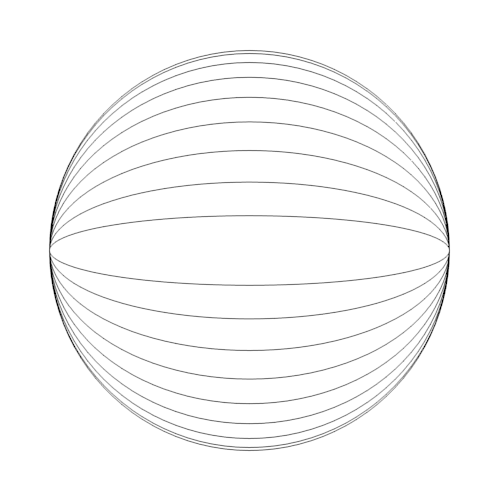
Helpfully they also show what these inclination angles would look like in comparison to the ellipses they fitted to the actual data. What's really surprising is that these "corrected" ellipses are often very close indeed to the measured fit, sometimes almost perfectly overlapping despite an error of 20 degrees or more. I even had to manually plot the circles myself to convince myself that this is correct. It is. Should I ever give another course, I'll be sure to add a plot of what inclination angles look like in practise. Here's a simple version that uses thin discs - the thick disc formula is more complicated and I can't be bothered to show that right now.

Circles inclined from 0 (outer) to 80 degrees in steps of 10 degrees.
When you're dealing with faint fuzzy blobs, I can easily believe that errors of tens of degrees are possible. The authors stop short of saying that the previous results suffered from this problem, as they did have gas maps as well as the optical, but it's hard to see the obvious implication. So maybe UDGs don't have anything much unusual about their dynamics at all, which re-opens the whole controversy about galaxies devoid of dark matter. We'll see.

Systematically Measuring Ultra Diffuse Galaxies in HI: Results from the Pilot Survey

We present neutral hydrogen (HI) observations using the Robert C. Byrd Green Bank Telescope (GBT) of 70 optically-detected UDG candidates in the Coma region from the Systematically Measuring Ultra-Diffuse Galaxies survey (SMUDGes). We detect HI in 18 targets, confirming 9 to be gas-rich UDGs and the remainder to be foreground dwarfs.

Thursday, 4 June 2020

Ghostly gas or just a ghost ?

Once upon a time, there was a lovely little gas cloud that turned into a star. That much we know. What we know a lot less about is exactly how gas clouds assemble into nice happy star-forming galaxies.

We know for certain that galaxies can lose gas through mutal interactions - we can directly see spectacular tails and streams that closely match predictions as to what such features should look like. But how gas gets into galaxies is much more controversial. Several streams have been proposed as signatures of accretion over the years, but it's never been very clear to me why any of them are more likely accretion features rather than tidal tails. If accretion happens, why don't we see it everywhere ?

This paper describes some exceptionally deep observations of two nearby edge-on galaxies, reaching density levels about ten times (or more) lower than more typical values. They do this is the old-fashioned way, by sheer observing time. That means they're limited to a few different "pointings" per galaxy - they don't produce any shiny maps, just spectra.

What they find, though, is in my opinion extremely suspicious. They detect neutral gas well above and below the plane of the discs, but it very closely matches the velocity profile of the disc - to within 10% or so of the velocity width. That just doesn't make any sense to me. Whatever the extraplanar gas is doing, there's no obvious reason why it should match the velocity width of the disc : tidal tails or infalling clouds should be all over the place. In some cases, they even see hints of a double-horn structure, a classic signature of a rotating disc. But you just shouldn't see that outside the disc itself : it couldn't be stable.

To be fair, this isn't seen everywhere. Some emission closer to the disc is a markedly different shape, but still with a very clear cutoff at the same velocity width of the disc. Going further out, in one case the emission appears to drop and then get stronger again. That sounds a lot like a sidelobe detection to me - detecting the galaxy's disc again because the sensitivity profile of the dish varies non-linearly with distance from the target.

EDIT : Although they don't explicitly discuss sidelobes, they do something much better and show a figure of the beam strength. While they claim that the emission they detect is well above the beam strength, I find it even more suspicious that their detected emission peaks at locations very close indeed to the sidelobes.

Perhaps I'm wrong. At least a few of the authors are way more experienced than me, but they only mention sidelobes once in passing (to say that they're weak). They discuss several possible origins for the gas, but rarely address that suspicious similarity in velocity widths except to note that it's "close to the velocity range expected for random motions in the halos of the galaxies". I don't find that terribly likely, so I'm far from convinced. I should get back to my cloud-mapping project...

Detection of the diffuse HI emission in the Circumgalactic Medium of NGC 891 and NGC 4565

We present detections of 21-cm emission from neutral hydrogen (HI) in the circumgalactic medium (CGM) of the local edge-on galaxies NGC 891 and NGC 4565 using the Robert C. Byrd Green Bank Telescope (GBT). With our 5$σ$ sensitivity of $8.2 \times 10^{16}$ cm$^{-2}$ calculated over a 20 km s$^{-1}$ channel, we achieve $>5σ$ detections out to $90-120$ kpc along the minor axes.

Why Bother ?

It's rare that I manage to read any longer pieces on arXiv that aren't strictly about galaxy evolution, but today I indulge myself. ...