Lecture 4/4 : All Hope Abandon, Ye Who Enter Here
And so at last my first foray in lecturing draws to a close. This time I look at problems in galaxy evolution and how they might be solved. The missing satellite problem is just one aspect in the much greater missing galaxy problem. After nearly 20 years, simulations are finally getting the number of predicted galaxies to match the observations... but they're so complicated, this doesn't necessarily mean they've got the answer right. Planes of satellite galaxies, whilst generating papers with hundreds of citations, I show are just pure nonsense and absolutely nothing to worry about, but if they're real then they're not the dark matter killer they're claimed to be. Ultra diffuse galaxies, dark galaxies, the Tully-Fisher relation, the mass discrepancy acceleration relation, and a showdown between MOND and CDM : it's all in here.
Regular blog rants about Jeremy Corbyn and Plato can now resume unhindered. I know y'all dying for that. :P
Though I'll probably be extracting parts of this to make shorter, more outreachy posts for those who don't want to wade through everything here.
This post is a placeholder. I will add a better summary here in due course.
Showing posts with label placeholder. Show all posts
Showing posts with label placeholder. Show all posts
Friday, 17 November 2017

Monday, 13 November 2017
Lecture 3/4 : Be Careful What You Wish For
This is the third part of my super-shortened course on galaxy evolution. You can find the complete transcript of the 90 minute lecture here, or you can stay with this post for the 9 minute version (if not less).
In galaxy studies we have very limited data and can't control our test subjects. Instead, we have to rely on restricted statistical data and numerical models, so it's crucial to understand the limitations of those models. Essentially this post is about why we interpret the data in the way we do, and why getting the right answer just isn't good enough. And there'll be some galaxy evolutionary theory thrown in as well, just for good measure.
The missing satellite problem
Simulations have gone from simple gravity models of the 1940's to the all-singing all-dancing models of today, from using a few tens of particles to a few billion (or more). Nowadays they can include full hydrodynamics, heating and cooling of the gas affected by radiation, heat conduction and chemistry, magnetic fields, and basically be as sophisticated as hell. Their major limit is that a lot of parameters can't be set from observational measurements - we have to guess them. More on that later.
It's good scientific practise to KISS : Keep It Simple, Stupid. Don't dive in to the really sophisticated models - begin with something much simpler, gradually increasing the complexity so you understand what each new factor is doing. For instance, the Millennium Simulation was a vast, 10 billion particle model of the evolution of the dark matter in the Universe. It contained absolutely nothing except collisionless but gravitationally-interacting dark matter particles. On the large scale this works really well :
Recall from the first lecture that this structure of filaments and voids is just what we see in reality. Great ! Except, no. On the smaller scales of individual galaxies, the model has problems.
Almost every dark matter halo in the simulation contains potentially detectable normal (baryonic) matter. The bottom line is that these kinds of semi-analytic models predict about ten times as many dwarf galaxies around the Milky Way as we actually observe. Since the dark matter is much more massive than the baryons, adding them in shouldn't be able to change the result very much - or at least that's the naive interpretation. First, we need to understand a bit more about the simulations themselves.
Simulations are not magical
I used to think that because you know all the physics at work in a simulation, you automatically understand whatever it does. Yet while you do get full 3D information with complete time evolution, you rarely get a full understanding of what's happening. For start, simulations have restrictions just as observations do. Their resolution is limited (e.g. by the number of particles and computational power), they don't include all the physical processes at work (because some are hard to simulate, while others are just not fully understood), and what we decide to simulate in the first place is heavily influenced by observations - which have their own problems. So they are, necessarily, simplified. It's important to try and convert our numerical predictions into something we can directly and fairly compare with observations.
The above example simply coloured the simulation particle data so that it looked like the original observations, but much more sophisticated approaches are possible. Creating synthetic observations adds even more complexity : you need, for instance, to model how the gas causes absorption and scattering of the light emitted from the stars, to replace your simulated generic gas particles with multiple gas phases, and a host of other factors besides.
While stars are generally simulated as n-bodies (point mass particles which have gravity but nothing else), the gas is more complex. There are two main ways of dealing with the hydrodynamic effects :
1) Smoothed particle hydrodynamics
In SPH codes the gas is modelled as a collection of particles. As well as having mass, each particle is deemed to be part of a kernel with its surrounding neighbours, over which the hydrodynamic equations can be solved. This then accounts for the variation in density, temperature, and pressure. In effect the particle data is transformed into something more like a continuous fluid.

With the kernels set to contain a fixed number of particles, the resolution of the simulation is adaptive : there are more computations where there are many interactions and less where there are fewer. And you can trace the history of each particle and find out where it originated. SPH suffers where there are sharp boundaries between different fluids though - it has difficulty reproducing observed structures.
2) Grid codes
Another approach is to do away with particles completely. Instead, a finite volume of space can be modelled as a grid of cells, each of which containing some fluid with density, temperature, pressure and velocity. Thus it models how gas can flow from cell to cell.
Cell sizes can vary so the resolution can be adaptive. Grid codes are much better at modelling hydrodynamic structures, but tend to be computationally expensive and there's no way of knowing where gas in any particular cell originated. So despite knowing all the initial conditions, there are fundamental restrictions on what you can learn from simulations.
Handle razors carefully !
Simulations, and especially the comparisons to observations, are complex beasts. Clearly there's some virtue in keeping things as simple as possible, but even here we have to be careful. There's a popular notion - spread by Jodie Foster in the film Contact - that Occam's Razor says that the simplest explanation tends to be right one. Occam, however, said no such thing. He said something more like, "entities must not be multiplied beyond necessity" - in essence, prefer simple explanations.
There are good reasons for this, but they have nothing to do with any kind of fundamental truth. Indeed, in science we should never presume to know how the world works : start thinking that the simplest explanation is usually correct and you rapidly degenerate into "a wizard did it". The Universe is a bloody complicated place, and sometimes it needs complex explanations.
John Von Neuman is reported to have said that with three free parameters he could fit an elephant, and with four he could make him wiggle his trunk. The more complex your explanation, the more you can adjust it to make it fit the observed data. Simpler explanations are much harder to fudge and therefore easier to test. But that absolutely does not mean that you never add complexity, because it's equally possible to over-simplify and miss some vital physical process.
In the case of the missing satellite problem, the complexity of the baryonic physics that we're missing from the pure dark matter simulations may have nothing to do with changing the halo structures at all. Instead it might be an example of a much more subtle selection effect.
Selection effects : correlation doesn't equal causation
We know the mass of the baryons is too small to affect the dark matter in our simulations. But we also know that the baryons are the only thing we can observe directly. So perhaps our simulations are missing some mechanism that restricts the presence of the baryons on only certain dark halos : maybe the rest do exist, but remain invisible. It's worth a brief digression here to show how important selection effects can be, and why statistical measurements can be woefully misleading.

The above chart comes from the fantastic website Spurious Correlations. This correlation is statistically significant, but physically meaningless. For a start, it's not at all clear which is the independent (controlling) variable : does excessive cheese consumption drive people insane and make them become entangled in their bedsheets, or do people commiserate bedsheet-based deaths by eating more cheese for some reason ? Both interpretations are equally absurd and the data says precisely nothing about which way round it goes.
Charts like those in Spurious Correlations are a variety of what's known as p-hacking : plot everything against everything and see what sticks. Surprisingly tight correlations can occur by chance if you plot enough variables together : what you're not being shown are the many variables which have no correlation whatsoever. Simply put, if something has a million to one chance of happening, if you give it a million opportunities to happen then it probably will. Other unexpected relations can occur because of common underlying factors with no direct connection between the two plotted variables.
Last time I mentioned different procedures for measuring the size of a galaxy, and we saw that despite being objective they gave very different results. As with automatic galaxy-finding algorithms that produce catalogues of low reliability, the point is that an objective procedure is not the same as being objectively correct. We'll see an example of this shortly and much more in lecture 4.
Unknown unknowns
So the observations of baryons may be severely limiting our view of the Universe. The naive expectation that adding in the baryons can't change the distribution of satellite galaxies predicted in the simulations may be over-simplifying : we might be witnessing a selection effect. Though it must be said that it isn't at all obvious as to the precise mechanism, it is at least conceivable that baryonic physics could limit which halos actually host visible galaxies.
Recently there's been some very interesting discoveries suggesting that that is indeed the case. While galaxies of especially low surface brightness have been known for ages, no-one thought they were numerically significant. That changed in 2015 with the discovery of 800 so-called ultra diffuse galaxies (UDGs) in the Coma cluster, galaxies which are about as large as the Milky Way but as much as a thousand times fainter.

UDGs have since been discovered in all kinds of environments, even in isolation. Most appear to be smooth and red but some are blue and structured, resembling standard LTGs but much fainter. Some are even known to have gas. At the moment, because UDGs are hard to identify, we can't say in which environment they're most common. More problematically, we can't quantify their typical dark matter content. If they're low mass, then UDGs at least alleviate (but do not solve) the missing satellite problem. But if they're massive, then they make things worse. It's of course possible that some are massive and some are not, but the important value is their typical mass, and that we just don't know at all.
If it disagrees with experiment, it'swrong annoying
You could be forgiven for thinking that there are enough problems with the standard model that we should just chuck it out and start again. There are indeed problems, but if we let every difficulty count as a falsification then every theory will have to be discarded. The point is that all our models have been over-simplifications, and without the full physics included we actually can't say if they're wrong or not : maybe they have fundamental problems, maybe they don't.
As mentioned, rare events happen by chance if given enough opportunities. We see this particularly in HI spectra, where the non-Gaussian nature of the noise means we sometimes see very convincing signals indeed that turn out to be spurious. My favourite example of all, though, is a simulation of these spectacular interacting galaxies :
A pretty good match - not perfect, but good. The problem is that this model of the galaxy's formation only included the disturbed galaxy and the elliptical, but subsequent observations found this :

A much larger third galaxy is clearly involved, but that wasn't included in the model. So the model has got the right answer - even in terms of quite fine structural details - by the wrong method ! Getting the right answer is a necessary but not sufficient condition for a good theory. The success of one model does not preclude the success of others.
Don't be hasty
We could turn to our models and say, "hmm, these all have problems, let's chuck them all out and start again", but this would be the wrong lesson to learn. A better lesson would be that if they have problems they need to be modified and improved : we must always be cautious. Only when we find a really deep flaw in the most fundamental nature of a model should we completely reject it.
While the standard dark matter model does have problems, it's also important to remember that it has tremendous successes as well. As well as reproducing the large-scale structure of the Universe, it also works extremely well at explaining colliding galaxy clusters. The Bullet Cluster and other cases show what happens after two clusters collide. Remember a cluster is a gravitationally bound structure containing its own dark matter, gas, and galaxies. If two clusters pass through each other, we'd expect the galaxies (bound by the collisioness dark matter of their parent clusters) to keep going but the gas to get stuck in the middle because of its large volume. That's exactly what happens, and, importantly, gravitational lensing confirms that the dark matter does exactly what it's supposed to. It's very hard to make this work without dark matter.
It's possible that we will eventually find a flaw with the standard model so fundamental that it can't be saved. But it's also possible that there are other, more nuanced aspects of physics we don't understand that could explain the problems without such a drastic rejection. For example, we know the main processes driving galaxy evolution today were very different in the past. Star formation activity peaked around 10 Gyr ago, as did AGN activity, and merger rates have also been decreasing. In the early Universe there were no galaxy clusters, so the processes of tidal encounters and ram pressure stripping would have been very different. There were also population III stars, far more energetic than any we see today, ionising large parts of the Universe ("squelching").
There are two main theories as to how galaxies assembled themselves. One is the idea of monolithic collapse, that huge rotating gas clouds simply collapsed and went thwoooop to form a galaxy. Simulations show that this is very successful. The problem is that there's no evidence or reason to suppose that such monoliths ever existed. Physics instead points to the now-dominant paradigm of hierarchical merging, where galaxies assemble themselves through the cannibalistic merging of smaller galaxies. This has plenty of problems besides the missing satellite issue, but is a far more natural expectation based on our understanding of physics.
Not even wrong ?
I'll finish with some final statistical lessons that we'll need for the concluding post. As mentioned, objective procedures are not necessarily objectively correct. A really wonderful example of this is provided by the datasaurus project. In the gif below, at every frame of the animation the positions of the points have exactly the same mean and standard deviation of their positions !
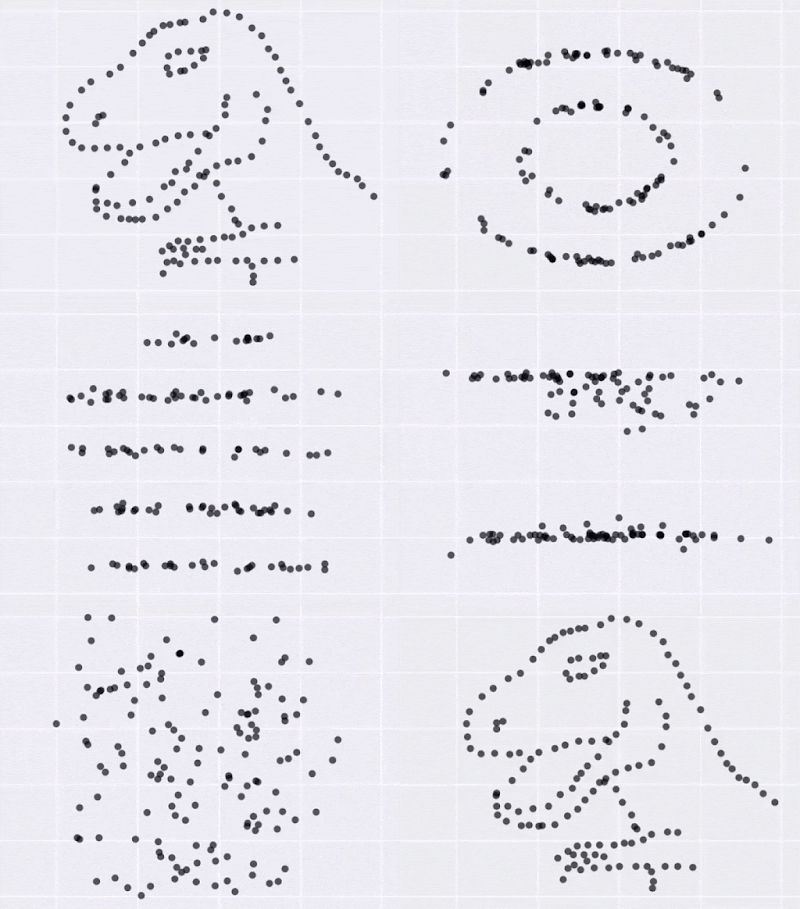
What this means is that quantification can sometimes of of limited help. You can't quantify "dinosauriness" by a simple parameter like mean position : you have to look at the data yourself. You can, should, and indeed must make statistical quantifications for your analysis. But you also have to look at the damn data, because while using quantitative parameters is fine, relying on them exclusively is an absolutely dreadful idea.
This isn't an abstract mathematical idea either. The US air force suffered from the flaw of averages when they designed their fighter aircraft based on the average dimensions of their pilots, not realising that very few pilots indeed were close to the averages in all parameters : everyone really is unique just like everyone else. This meant a loss of planes and pilots because in a fighter plane it's really, really important you can reach the controls when you need to. The solution ? Instead of tailoring each plane to each pilot, they developed adjustable seats so pilots could set things for themselves no matter which plane they flew.
That's my philosophy of science rant over. The main take-home lessons are :
In galaxy studies we have very limited data and can't control our test subjects. Instead, we have to rely on restricted statistical data and numerical models, so it's crucial to understand the limitations of those models. Essentially this post is about why we interpret the data in the way we do, and why getting the right answer just isn't good enough. And there'll be some galaxy evolutionary theory thrown in as well, just for good measure.
The missing satellite problem
Simulations have gone from simple gravity models of the 1940's to the all-singing all-dancing models of today, from using a few tens of particles to a few billion (or more). Nowadays they can include full hydrodynamics, heating and cooling of the gas affected by radiation, heat conduction and chemistry, magnetic fields, and basically be as sophisticated as hell. Their major limit is that a lot of parameters can't be set from observational measurements - we have to guess them. More on that later.
 |
| Example from the Illustris simulation. |
 |
| The raw particle data is on the left. Based on the observed relation between the dark matter mass of a galaxy and its visible light, the right hand panel is a prediction of what we would detect at optical wavelengths. |
 |
| As above, raw particle data on the left with predicted visible light (in red and blue) on the right. |
Simulations are not magical
I used to think that because you know all the physics at work in a simulation, you automatically understand whatever it does. Yet while you do get full 3D information with complete time evolution, you rarely get a full understanding of what's happening. For start, simulations have restrictions just as observations do. Their resolution is limited (e.g. by the number of particles and computational power), they don't include all the physical processes at work (because some are hard to simulate, while others are just not fully understood), and what we decide to simulate in the first place is heavily influenced by observations - which have their own problems. So they are, necessarily, simplified. It's important to try and convert our numerical predictions into something we can directly and fairly compare with observations.
 |
| Simulation (left) and observation (right) of the Auriga's Wheel galaxies. |
While stars are generally simulated as n-bodies (point mass particles which have gravity but nothing else), the gas is more complex. There are two main ways of dealing with the hydrodynamic effects :
1) Smoothed particle hydrodynamics
In SPH codes the gas is modelled as a collection of particles. As well as having mass, each particle is deemed to be part of a kernel with its surrounding neighbours, over which the hydrodynamic equations can be solved. This then accounts for the variation in density, temperature, and pressure. In effect the particle data is transformed into something more like a continuous fluid.

With the kernels set to contain a fixed number of particles, the resolution of the simulation is adaptive : there are more computations where there are many interactions and less where there are fewer. And you can trace the history of each particle and find out where it originated. SPH suffers where there are sharp boundaries between different fluids though - it has difficulty reproducing observed structures.
2) Grid codes
Another approach is to do away with particles completely. Instead, a finite volume of space can be modelled as a grid of cells, each of which containing some fluid with density, temperature, pressure and velocity. Thus it models how gas can flow from cell to cell.
Cell sizes can vary so the resolution can be adaptive. Grid codes are much better at modelling hydrodynamic structures, but tend to be computationally expensive and there's no way of knowing where gas in any particular cell originated. So despite knowing all the initial conditions, there are fundamental restrictions on what you can learn from simulations.
Handle razors carefully !
Simulations, and especially the comparisons to observations, are complex beasts. Clearly there's some virtue in keeping things as simple as possible, but even here we have to be careful. There's a popular notion - spread by Jodie Foster in the film Contact - that Occam's Razor says that the simplest explanation tends to be right one. Occam, however, said no such thing. He said something more like, "entities must not be multiplied beyond necessity" - in essence, prefer simple explanations.
There are good reasons for this, but they have nothing to do with any kind of fundamental truth. Indeed, in science we should never presume to know how the world works : start thinking that the simplest explanation is usually correct and you rapidly degenerate into "a wizard did it". The Universe is a bloody complicated place, and sometimes it needs complex explanations.
John Von Neuman is reported to have said that with three free parameters he could fit an elephant, and with four he could make him wiggle his trunk. The more complex your explanation, the more you can adjust it to make it fit the observed data. Simpler explanations are much harder to fudge and therefore easier to test. But that absolutely does not mean that you never add complexity, because it's equally possible to over-simplify and miss some vital physical process.
In the case of the missing satellite problem, the complexity of the baryonic physics that we're missing from the pure dark matter simulations may have nothing to do with changing the halo structures at all. Instead it might be an example of a much more subtle selection effect.
Selection effects : correlation doesn't equal causation
We know the mass of the baryons is too small to affect the dark matter in our simulations. But we also know that the baryons are the only thing we can observe directly. So perhaps our simulations are missing some mechanism that restricts the presence of the baryons on only certain dark halos : maybe the rest do exist, but remain invisible. It's worth a brief digression here to show how important selection effects can be, and why statistical measurements can be woefully misleading.

The above chart comes from the fantastic website Spurious Correlations. This correlation is statistically significant, but physically meaningless. For a start, it's not at all clear which is the independent (controlling) variable : does excessive cheese consumption drive people insane and make them become entangled in their bedsheets, or do people commiserate bedsheet-based deaths by eating more cheese for some reason ? Both interpretations are equally absurd and the data says precisely nothing about which way round it goes.
 |
| From this paper. |
A second example : the pitch angle of spiral arms (a measure of how tightly wound they are) in galaxies correlates with the mass of their supermassive black hole. This is completely unexpected because the central black holes, though massive, are minuscule in comparison to most spiral galaxies. Local gravity sources (e.g. ordinary stars) ought to dominate at large distances - there's no plausible direct connection between the black hole and something as large as a spiral arm. But there might, the authors suggest, be a connection between a third factor such as the density profile of the dark matter.
Charts like those in Spurious Correlations are a variety of what's known as p-hacking : plot everything against everything and see what sticks. Surprisingly tight correlations can occur by chance if you plot enough variables together : what you're not being shown are the many variables which have no correlation whatsoever. Simply put, if something has a million to one chance of happening, if you give it a million opportunities to happen then it probably will. Other unexpected relations can occur because of common underlying factors with no direct connection between the two plotted variables.
Last time I mentioned different procedures for measuring the size of a galaxy, and we saw that despite being objective they gave very different results. As with automatic galaxy-finding algorithms that produce catalogues of low reliability, the point is that an objective procedure is not the same as being objectively correct. We'll see an example of this shortly and much more in lecture 4.
Unknown unknowns
So the observations of baryons may be severely limiting our view of the Universe. The naive expectation that adding in the baryons can't change the distribution of satellite galaxies predicted in the simulations may be over-simplifying : we might be witnessing a selection effect. Though it must be said that it isn't at all obvious as to the precise mechanism, it is at least conceivable that baryonic physics could limit which halos actually host visible galaxies.
Recently there's been some very interesting discoveries suggesting that that is indeed the case. While galaxies of especially low surface brightness have been known for ages, no-one thought they were numerically significant. That changed in 2015 with the discovery of 800 so-called ultra diffuse galaxies (UDGs) in the Coma cluster, galaxies which are about as large as the Milky Way but as much as a thousand times fainter.

UDGs have since been discovered in all kinds of environments, even in isolation. Most appear to be smooth and red but some are blue and structured, resembling standard LTGs but much fainter. Some are even known to have gas. At the moment, because UDGs are hard to identify, we can't say in which environment they're most common. More problematically, we can't quantify their typical dark matter content. If they're low mass, then UDGs at least alleviate (but do not solve) the missing satellite problem. But if they're massive, then they make things worse. It's of course possible that some are massive and some are not, but the important value is their typical mass, and that we just don't know at all.
If it disagrees with experiment, it's
You could be forgiven for thinking that there are enough problems with the standard model that we should just chuck it out and start again. There are indeed problems, but if we let every difficulty count as a falsification then every theory will have to be discarded. The point is that all our models have been over-simplifications, and without the full physics included we actually can't say if they're wrong or not : maybe they have fundamental problems, maybe they don't.
 |
| Occam's Razor is useful, but there is such a thing as over-simplifying. |
 |
| From this paper. The northern elliptical galaxy is included in the simulation but is just out of the field of view. |

A much larger third galaxy is clearly involved, but that wasn't included in the model. So the model has got the right answer - even in terms of quite fine structural details - by the wrong method ! Getting the right answer is a necessary but not sufficient condition for a good theory. The success of one model does not preclude the success of others.
Don't be hasty
We could turn to our models and say, "hmm, these all have problems, let's chuck them all out and start again", but this would be the wrong lesson to learn. A better lesson would be that if they have problems they need to be modified and improved : we must always be cautious. Only when we find a really deep flaw in the most fundamental nature of a model should we completely reject it.
While the standard dark matter model does have problems, it's also important to remember that it has tremendous successes as well. As well as reproducing the large-scale structure of the Universe, it also works extremely well at explaining colliding galaxy clusters. The Bullet Cluster and other cases show what happens after two clusters collide. Remember a cluster is a gravitationally bound structure containing its own dark matter, gas, and galaxies. If two clusters pass through each other, we'd expect the galaxies (bound by the collisioness dark matter of their parent clusters) to keep going but the gas to get stuck in the middle because of its large volume. That's exactly what happens, and, importantly, gravitational lensing confirms that the dark matter does exactly what it's supposed to. It's very hard to make this work without dark matter.
 |
| Overlaid on the optical images are X-ray gas in pink and dark matter (from lensing) in blue. |
There are two main theories as to how galaxies assembled themselves. One is the idea of monolithic collapse, that huge rotating gas clouds simply collapsed and went thwoooop to form a galaxy. Simulations show that this is very successful. The problem is that there's no evidence or reason to suppose that such monoliths ever existed. Physics instead points to the now-dominant paradigm of hierarchical merging, where galaxies assemble themselves through the cannibalistic merging of smaller galaxies. This has plenty of problems besides the missing satellite issue, but is a far more natural expectation based on our understanding of physics.
Not even wrong ?
I'll finish with some final statistical lessons that we'll need for the concluding post. As mentioned, objective procedures are not necessarily objectively correct. A really wonderful example of this is provided by the datasaurus project. In the gif below, at every frame of the animation the positions of the points have exactly the same mean and standard deviation of their positions !
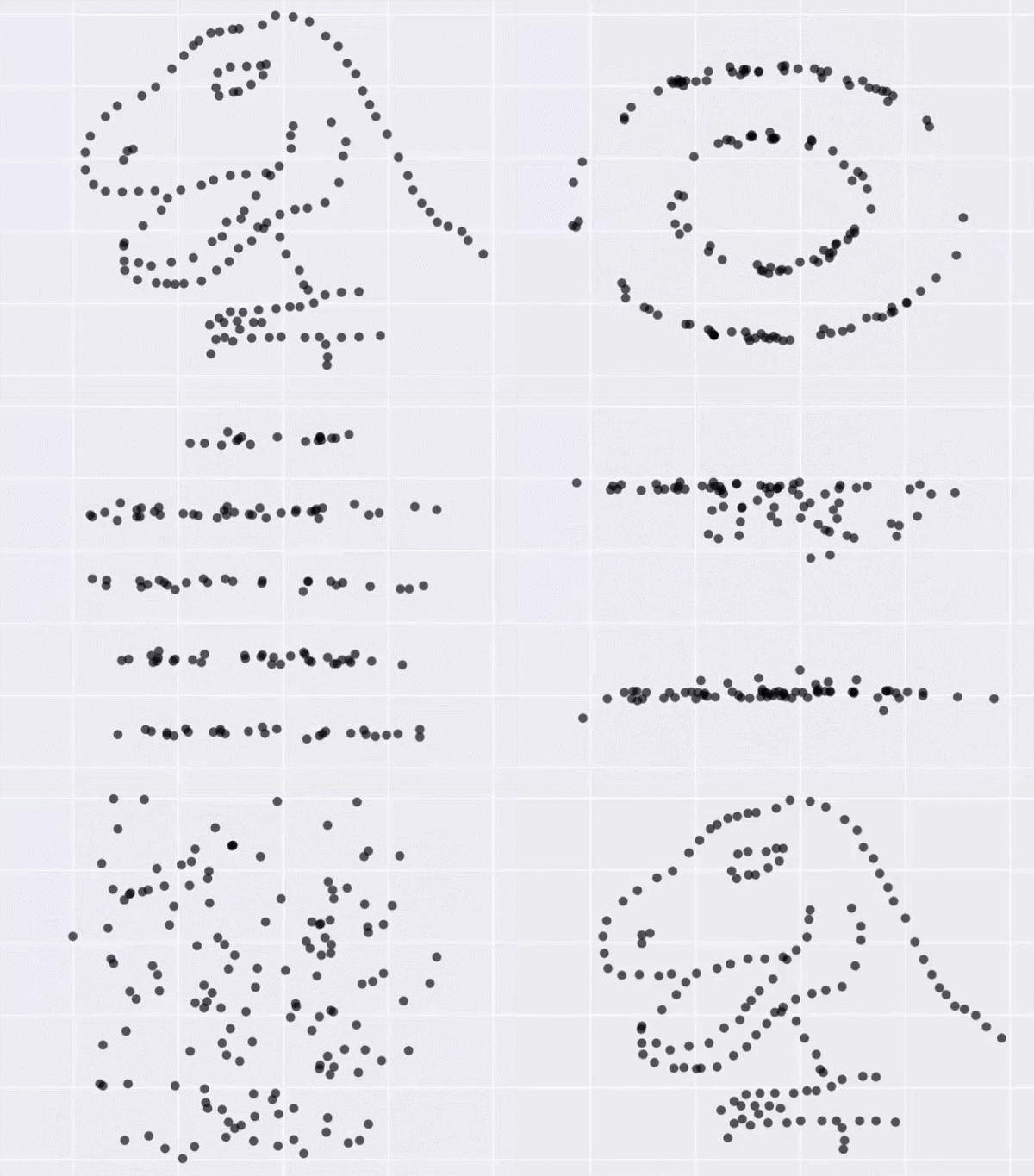
What this means is that quantification can sometimes of of limited help. You can't quantify "dinosauriness" by a simple parameter like mean position : you have to look at the data yourself. You can, should, and indeed must make statistical quantifications for your analysis. But you also have to look at the damn data, because while using quantitative parameters is fine, relying on them exclusively is an absolutely dreadful idea.
This isn't an abstract mathematical idea either. The US air force suffered from the flaw of averages when they designed their fighter aircraft based on the average dimensions of their pilots, not realising that very few pilots indeed were close to the averages in all parameters : everyone really is unique just like everyone else. This meant a loss of planes and pilots because in a fighter plane it's really, really important you can reach the controls when you need to. The solution ? Instead of tailoring each plane to each pilot, they developed adjustable seats so pilots could set things for themselves no matter which plane they flew.
That's my philosophy of science rant over. The main take-home lessons are :
- Prefer simple explanations (but don't go thinking that simpler means its more likely to be true, it's just easier to test)
- Objective procedures are not necessarily objectively correct - and indeed there are some things you just can't quantify at all
- Different models can be equally successful - always try and test multiple explanations, because the fact that one model works well doesn't meant that others are disproven
- The interpretation of what the data means is down to you and you alone. No algorithm can tell you what the data really means. Do not avoid statistical testing, but don't avoid subjective judgements either.
Thursday, 3 August 2017
The most useless law in nature ?
In which I summarise the current debate over whether this apparent "new law of nature" means anything or not, and conclude (spoiler !) that it probably doesn't.
It's been known for many years that there's a correlation between how fast matter in a galaxy rotates and how much gas and stars it contains. The problem is that there shouldn't be a nice relation, because galaxies seem to be dominated by dark matter. This strange relationship between normal and dark matter, which should be independent of each other, has been shown in different ways over the years. Recently it was claimed that all of these are just manifestations of a deeper underlying "law" : the Mass Discrepancy Acceleration Relation (or technically the Radial Acceleration Relation, but whatever).
The problem is that the expected acceleration of matter (based on its mass and standard Newtonian gravity) correlates very, very well with its actual acceleration. If there is, as we think for many other reasons, actually a huge amount of unseen "dark matter" present, then it shouldn't do that. Could it be that the dark matter theory is wrong ?
YES ! But it probably isn't. Although modified theories of gravity do predict this relation - indeed, did predict it 30 years ago - it seems that it also occurs in standard dark matter simulations without any difficulties. You can see a comparison of observations (left) and the simulations (right) in the example image below. Since both modifying gravity and using dark matter give the same result, this discovery is probably useless. Weird, but useless.
Read on for tales of academics behaving badly, pretty pictures of galaxies, lots of and lots of graphs, and a surprised dog...
Placeholder post intended to be replaced with a slightly better summary.
It's been known for many years that there's a correlation between how fast matter in a galaxy rotates and how much gas and stars it contains. The problem is that there shouldn't be a nice relation, because galaxies seem to be dominated by dark matter. This strange relationship between normal and dark matter, which should be independent of each other, has been shown in different ways over the years. Recently it was claimed that all of these are just manifestations of a deeper underlying "law" : the Mass Discrepancy Acceleration Relation (or technically the Radial Acceleration Relation, but whatever).
The problem is that the expected acceleration of matter (based on its mass and standard Newtonian gravity) correlates very, very well with its actual acceleration. If there is, as we think for many other reasons, actually a huge amount of unseen "dark matter" present, then it shouldn't do that. Could it be that the dark matter theory is wrong ?
YES ! But it probably isn't. Although modified theories of gravity do predict this relation - indeed, did predict it 30 years ago - it seems that it also occurs in standard dark matter simulations without any difficulties. You can see a comparison of observations (left) and the simulations (right) in the example image below. Since both modifying gravity and using dark matter give the same result, this discovery is probably useless. Weird, but useless.
Read on for tales of academics behaving badly, pretty pictures of galaxies, lots of and lots of graphs, and a surprised dog...
Placeholder post intended to be replaced with a slightly better summary.
Monday, 31 July 2017
Ghostly giants versus huge dwarves - the battle continues
Ghostly giants versus huge dwarves - the battle continues
Ultra-diffuse galaxies are currently the trendiest thing in extragalactic astronomy. The same size as the Milky Way but a thousand times fainter, these things may be extremely boring to look at but they break all the rules of galaxy formation. Or do they ? Two years after first hitting the headlines, I review the current state of the art on the most important question : how massive are they ? Are they actually just huge dwarves or are they genuinely ghostly giants ? What have we really learned so far and where are we going ?
With star-studded cast of a giant squid, Father Ted, Gimli, Ghostbusters and for some reason James Corden...
Placeholder post intended to be replaced with a better summary.
Ultra-diffuse galaxies are currently the trendiest thing in extragalactic astronomy. The same size as the Milky Way but a thousand times fainter, these things may be extremely boring to look at but they break all the rules of galaxy formation. Or do they ? Two years after first hitting the headlines, I review the current state of the art on the most important question : how massive are they ? Are they actually just huge dwarves or are they genuinely ghostly giants ? What have we really learned so far and where are we going ?
With star-studded cast of a giant squid, Father Ted, Gimli, Ghostbusters and for some reason James Corden...
Placeholder post intended to be replaced with a better summary.
Wednesday, 9 November 2016
Visualising 3D data in arbitrary coordinates
I had a paper accepted. It doesn't seem very important now though, because America has decided to take all that was great and good about itself and crap all over it. Still, you can read the full version here.
https://arxiv.org/abs/1611.02517
https://arxiv.org/abs/1611.02517
Saturday, 27 August 2016
Ten Dark Galaxies That Are Way More Awesome Than Dragonfly 44
Ten Dark Galaxies That Are Way More Awesome Than Dragonfly 44
.... no, not really. Well maybe not. Thing is, it's complicated.
Dragonfly 44 is this very faint dark matter dominated galaxy that's currently getting a lot of media attention. And rightly so, because it is very strange. At least it might be. But we don't yet know for sure just how strange it is : if it's as massive as has been directly measured, it's not that weird. However if it's as massive as the estimates suggest, then it's really very strange indeed.
As I show in this post, we already knew of a lot of optically very faint objects that are very hard to explain. We don't know how gas gets into the dark matter halos in the first place, and we definitely don't know how it turns into stars. So Dragonfly 44 doesn't break those aspects of galaxy formation theory, because they were already in a pretty bad shape anyway.
But what cosmological models predicted was that there should be a lot more very small galaxies than we'd previously detected. Recent discoveries looked like they were beginning to find them... not in sufficient numbers, but enough to hope that maybe the theory wasn't so bad after all. Dragonfly 44 might throw a spanner in the works, if its mass is as high as the estimate suggest. There was never much of a problem with the theory for galaxies of this mass, it seemed to be in decent agreement with the observations.
So Dragonfly 44, together with a bunch of other observations, might indicate that there are a whole load of giant dark galaxies that were never predicted by the theory. That could be a big problem. But I'd reserve judgement for the moment, for two reasons. Firstly, we don't have many good mass estimate for these new galaxies - and those we do have suggest the majority are dwarves after all. Second, the high mass estimate for Dragonfly 44 is a huge extrapolation based on the known-to-be-flawed numerical simulations.
What's the answer ? I have no idea. It's not the sort of thing that can be answered in a blog post, it's the kind of thing you need many different people to look at for the next several years. Right now we don't even really know the nature of the problem. It could be potentially very exciting, but it's just far too early to tell.
Placeholder post intended to be replaced with a better summary.
.... no, not really. Well maybe not. Thing is, it's complicated.
Dragonfly 44 is this very faint dark matter dominated galaxy that's currently getting a lot of media attention. And rightly so, because it is very strange. At least it might be. But we don't yet know for sure just how strange it is : if it's as massive as has been directly measured, it's not that weird. However if it's as massive as the estimates suggest, then it's really very strange indeed.
As I show in this post, we already knew of a lot of optically very faint objects that are very hard to explain. We don't know how gas gets into the dark matter halos in the first place, and we definitely don't know how it turns into stars. So Dragonfly 44 doesn't break those aspects of galaxy formation theory, because they were already in a pretty bad shape anyway.
But what cosmological models predicted was that there should be a lot more very small galaxies than we'd previously detected. Recent discoveries looked like they were beginning to find them... not in sufficient numbers, but enough to hope that maybe the theory wasn't so bad after all. Dragonfly 44 might throw a spanner in the works, if its mass is as high as the estimate suggest. There was never much of a problem with the theory for galaxies of this mass, it seemed to be in decent agreement with the observations.
So Dragonfly 44, together with a bunch of other observations, might indicate that there are a whole load of giant dark galaxies that were never predicted by the theory. That could be a big problem. But I'd reserve judgement for the moment, for two reasons. Firstly, we don't have many good mass estimate for these new galaxies - and those we do have suggest the majority are dwarves after all. Second, the high mass estimate for Dragonfly 44 is a huge extrapolation based on the known-to-be-flawed numerical simulations.
What's the answer ? I have no idea. It's not the sort of thing that can be answered in a blog post, it's the kind of thing you need many different people to look at for the next several years. Right now we don't even really know the nature of the problem. It could be potentially very exciting, but it's just far too early to tell.
Placeholder post intended to be replaced with a better summary.
Wednesday, 17 February 2016
How not to build a galaxy.
And more importantly, how not to build a galaxy. Uniform discs of pure gas turn out to be almost impossible. Exponential discs - where there's a much greater density in the centre - work, but they don't match observations. By far and away the easiest solution is to add a gazillion tonnes of dark matter. That stabilises everything to the point where the disc becomes practically indestructible.
I also look at a claim by some mathematicians that you don't need dark matter because the gravitational field of a disc is very different to sphere. It turns out the field is very different - and this is often overlooked - but this cannot possibly explain why galaxies are rotating so fast. Although they do some mathematics that's way too complicated for me, I found a way to sidestep that and get the same results. The flaw in their argument is that they use a density profile that's completely ruled out by observations, and doesn't give that good a result anyway. They also neglect the fact that the gas is a fluid but actually you can't approximate this as a simply a collection of orbiting points - even if you use the prescribed formula that accounts for the gravity correctly, the thing tears itself apart in a wide variety of interesting ways.
Whatever its faults on other scales, dark matter really is the easiest solution here.
Placeholder post intended to be replaced with a better summary.
I also look at a claim by some mathematicians that you don't need dark matter because the gravitational field of a disc is very different to sphere. It turns out the field is very different - and this is often overlooked - but this cannot possibly explain why galaxies are rotating so fast. Although they do some mathematics that's way too complicated for me, I found a way to sidestep that and get the same results. The flaw in their argument is that they use a density profile that's completely ruled out by observations, and doesn't give that good a result anyway. They also neglect the fact that the gas is a fluid but actually you can't approximate this as a simply a collection of orbiting points - even if you use the prescribed formula that accounts for the gravity correctly, the thing tears itself apart in a wide variety of interesting ways.
Whatever its faults on other scales, dark matter really is the easiest solution here.
Placeholder post intended to be replaced with a better summary.
Tuesday, 10 November 2015
Keenan's Ring
"Keenan's Ring" is the name we're giving to a giant starless cloud of hydrogen discovered near the Triangulum galaxy, M33. This is the largest, most massive hydrogen cloud discovered in the region since Wright's Cloud in 1979. In angular size it's about as large as the hydrogen disc of M33 (five times larger than the full Moon) and it's just been sitting there all this time, but it's so faint no-one had noticed it before. Well, not quite, but no-one realised just how large it was or that it was a ring.
Why does this matter ? Well, we don't have a good explanation for this object. The nearby Wright's Cloud is thought to be part of the much larger Magellanic Stream, but there's no obvious reason why there should be two large clouds at the end but offset at right-angles to the stream. Nor is it obvious why this one should be a ring - there's no particular reason to expect the gas to be missing in the centre of the structure. It's not likely to be a dark galaxy either (an object made of dark matter, gas, but without stars), because the velocity width is much smaller than would be expected. On the other hand, it does have a small velocity gradient, suggesting that it is a single coherent structure and not a chance alignment of lots of smaller clouds. It really is a mystery.
The figure shows the 3D data cube obtained with five years of Arecibo observations. The third axis is velocity, not distance (see link for details). Colours are chosen just to highlight different structures : blue for the Milky Way, red for everything else. The data looks noisy at one end but this is just because of how the data was processed. Keenan's Ring can be seen in this noisy red part of the data, but there are better images in the linked post.
Placeholder post intended to be replaced with a better summary.
Why does this matter ? Well, we don't have a good explanation for this object. The nearby Wright's Cloud is thought to be part of the much larger Magellanic Stream, but there's no obvious reason why there should be two large clouds at the end but offset at right-angles to the stream. Nor is it obvious why this one should be a ring - there's no particular reason to expect the gas to be missing in the centre of the structure. It's not likely to be a dark galaxy either (an object made of dark matter, gas, but without stars), because the velocity width is much smaller than would be expected. On the other hand, it does have a small velocity gradient, suggesting that it is a single coherent structure and not a chance alignment of lots of smaller clouds. It really is a mystery.
The figure shows the 3D data cube obtained with five years of Arecibo observations. The third axis is velocity, not distance (see link for details). Colours are chosen just to highlight different structures : blue for the Milky Way, red for everything else. The data looks noisy at one end but this is just because of how the data was processed. Keenan's Ring can be seen in this noisy red part of the data, but there are better images in the linked post.
Placeholder post intended to be replaced with a better summary.
Friday, 30 October 2015
Isolated galaxies with AGES
MOOOAAR PAPERS ! Congratulations Robert Minchin and Olivia Keenan. And me, too... :)
We looked at some isolated galaxies in case they weren't actually isolated, but it turns out that they were. Oh well, never mind.
Maybe I'll do less pithy analysis when I have time...
http://arxiv.org/abs/1510.08715
We looked at some isolated galaxies in case they weren't actually isolated, but it turns out that they were. Oh well, never mind.
Maybe I'll do less pithy analysis when I have time...
http://arxiv.org/abs/1510.08715
Tuesday, 13 October 2015
A thousand galaxies just isn't enough
A Thousand Galaxies Discovered In The Coma Cluster... but it's still not enough
In this article linked below I cover a few different papers. At least 300 galaxies have been recently discovered in the Coma cluster which are about as large as the Milky Way, but a thousand times fainter. Hundreds more smaller galaxies have also been found there, and also in the closer Virgo cluster by another team. Hooray, more galaxies ? Everyone loves galaxies, right ?
Well, sort-of. Galaxies are definitely, objectively awesome. But cosmological models predict far more galaxies than we actually observe. The new discoveries are spectacular in that they uncover a huge population of what were unusually large, faint objects, which probably need a lot of dark matter just to survive being torn apart inside the clusters. On the other hand, the numbers of smaller galaxies being found is just nowhere near enough to save the models.
Could it be that those models are just plain wrong ? Sure. But right now, there are so many difficulties in the details of establishing exactly what the models predict, it's probably premature to throw them out just yet. The only safe conclusion is that for now, we don't really understand what's going on.
... with guest appearances by the Doctor, Godzilla, and Gimli the dwarf...
Placeholder post intended to be replaced with a better summary.
In this article linked below I cover a few different papers. At least 300 galaxies have been recently discovered in the Coma cluster which are about as large as the Milky Way, but a thousand times fainter. Hundreds more smaller galaxies have also been found there, and also in the closer Virgo cluster by another team. Hooray, more galaxies ? Everyone loves galaxies, right ?
Well, sort-of. Galaxies are definitely, objectively awesome. But cosmological models predict far more galaxies than we actually observe. The new discoveries are spectacular in that they uncover a huge population of what were unusually large, faint objects, which probably need a lot of dark matter just to survive being torn apart inside the clusters. On the other hand, the numbers of smaller galaxies being found is just nowhere near enough to save the models.
Could it be that those models are just plain wrong ? Sure. But right now, there are so many difficulties in the details of establishing exactly what the models predict, it's probably premature to throw them out just yet. The only safe conclusion is that for now, we don't really understand what's going on.
... with guest appearances by the Doctor, Godzilla, and Gimli the dwarf...
Placeholder post intended to be replaced with a better summary.
Monday, 30 March 2015
The Absurdly Anthropic
In today's thrilling blog post, I look at the anthropic principle, why it's sometimes trivial-but-useful, but sometimes a complete load of hooey.
The weak anthropic principle basically states that the Universe is the way it is because things happened the way they did. It's unfortunate, and completely unnecessary, that it's more often stated to be about sentient life, because it really isn't. The idea is that by knowing the contents of the Universe, you can constrain the processes that must have happened to form such contents. It really doesn't make any difference if you choose to explain the existence of turkeys, sand, or clouds - using sentient life only sounds mystical if you think there's something fundamentally special about it.
The strong anthropic principle ties in with the idea that the Universe is so carefully fine-tuned to support intelligent life that there must have been a designer. This is wrong every way you look at it. There are so many fundamental parameters that fine-tuning is a myth - if you just alter one, then sure you'll screw everything up and the Universe won't support life anymore. But if you alter two or three...
Moreover, the idea that the Universe looks designed specifically for us, rather than intelligent life in general, looks decidedly ropey to me. Most of the Universe is a complete hell-hole as far as human life is concerned. Even the Earth is often an incredibly hostile place to live - we survive in spite of our environment as much as because of it.
Not that the lack of fine-tuning in any way diminishes the astounding fact that we exist at all. Our existence may be incredibly unlikely, but that in no way requires the hand of a designer.
Placeholder post intended to be replaced with a better summary.
The weak anthropic principle basically states that the Universe is the way it is because things happened the way they did. It's unfortunate, and completely unnecessary, that it's more often stated to be about sentient life, because it really isn't. The idea is that by knowing the contents of the Universe, you can constrain the processes that must have happened to form such contents. It really doesn't make any difference if you choose to explain the existence of turkeys, sand, or clouds - using sentient life only sounds mystical if you think there's something fundamentally special about it.
The strong anthropic principle ties in with the idea that the Universe is so carefully fine-tuned to support intelligent life that there must have been a designer. This is wrong every way you look at it. There are so many fundamental parameters that fine-tuning is a myth - if you just alter one, then sure you'll screw everything up and the Universe won't support life anymore. But if you alter two or three...
Moreover, the idea that the Universe looks designed specifically for us, rather than intelligent life in general, looks decidedly ropey to me. Most of the Universe is a complete hell-hole as far as human life is concerned. Even the Earth is often an incredibly hostile place to live - we survive in spite of our environment as much as because of it.
Not that the lack of fine-tuning in any way diminishes the astounding fact that we exist at all. Our existence may be incredibly unlikely, but that in no way requires the hand of a designer.
Placeholder post intended to be replaced with a better summary.
Friday, 8 August 2014
Introducing FRELLED
Why your ancestors not being eaten by a lion makes you well-suited to detecting extragalactic hydrogen, and the amount of work that goes into a few paragraphs in a publication. Also, why Blender is really really cool.
Placeholder post intended to be replaced with a better summary.
Placeholder post intended to be replaced with a better summary.
Wednesday, 2 July 2014
PAPER ACCEPTED ! I HAS ALL THE WIN !
PAPER ACCEPTED ! I HAS ALL THE WIN !
Err, I mean, this is an important breakthrough which will revolutionise science and push the boundaries of human knowledge !
... no, that's not right either...
This is a fairly interesting discovery which gently prods the boundaries of human knowledge. We found a bunch of galaxies with some extremely long gas streams, which is kindof neat. We're doing a press release on this one, but you heard it here first.
I'll have more to say on this, of course. Placeholder post intended to be replaced with a better summary.
http://arxiv.org/abs/1407.0016
Err, I mean, this is an important breakthrough which will revolutionise science and push the boundaries of human knowledge !
... no, that's not right either...
This is a fairly interesting discovery which gently prods the boundaries of human knowledge. We found a bunch of galaxies with some extremely long gas streams, which is kindof neat. We're doing a press release on this one, but you heard it here first.
I'll have more to say on this, of course. Placeholder post intended to be replaced with a better summary.
http://arxiv.org/abs/1407.0016
Wednesday, 9 April 2014
The lonely little smurf
My third paper accepted !
It's about an isolated blue dwarf galaxy. Why the hell didn't I call it AGES VIII : The Lonely Little Smurf ?
A slightly worrying thought occurs that when paper VII is accepted I'll have written half of all the AGES papers...
Placeholder post intended to be replaced with a better summary.
http://arxiv.org/abs/1404.2101
It's about an isolated blue dwarf galaxy. Why the hell didn't I call it AGES VIII : The Lonely Little Smurf ?
A slightly worrying thought occurs that when paper VII is accepted I'll have written half of all the AGES papers...
Placeholder post intended to be replaced with a better summary.
http://arxiv.org/abs/1404.2101
Subscribe to:
Posts (Atom)
ChatGPT Is A Competent Source Extractor
This builds on my post from two years ago, ChatGPT Is Not A Source Extractor . My, how things change. Last time I wrote : They're still ...
