Last night, they were taking about 40 exposures of the night sky, looking towards the small and large magellanic clouds, two dwarf galaxies that neighbor the Milky Way. But during one set of those observations, 90 minutes before sunrise, the train of SpaceX’s Starlink satellites moved into view, glinting in the early morning sunlight and taking five minutes to pass across the telescope's line of sight.
"This happened just before astronomical twilight," says Johnson. "By almost any observing standard this was still the heart of the night, exactly when you want to be taking data. And especially when you want to use every minute of observing time you get on these telescopes and these facilities."
There are several factors that could affect how much worse this will get :
The number of satellites : "So far, SpaceX has launched just 0.14 percent of its total planned Starlink constellation.... Bassa has calculated that up to 140 satellites could be visible at any one time if all the planned satellites launch.". Doesn't specify what's meant by "visible" here, i.e. in what field of view.
The altitude of the satellites : "The satellites were deployed in a long train at an altitude of 280 kilometers... but are in the process of being raised to their operational altitude of 550 kilometers". The higher they are, the longer they'll reflect sunlight, though they will also be fainter.
The albedo of the satellites : "...painting future Starlink satellites black to reduce their reflectivity, although it’s not believed this was done for this latest batch – while the glinting of the large solar panels on each satellite still poses a problem."
On the second point, it would be nice to know exactly how long before twilight this was. There are detailed, credible-sounding articles saying that the satellites impact on astronomy will be minimal, but that they're visible even in full night somewhat contradicts that. So just how much astronomical night will be lost ? If it's five minutes then that's not awful (although I wonder how much this will affect flat fields also), but if it's longer then that could be a big deal. Especially for targets of opportunity, which can't be neatly scheduled to avoid inconvenient hours. Maybe painting them black will be enough, but wouldn't it be nice to test this before going full throttle ?
[Walks away angrily singing the Firefly theme tune...]
In the early hours of the morning today, November 18, two astronomers checked in on their remotely operated telescope in Chile, expecting to see images of distant stars and galaxies. Instead, they saw a train of SpaceX satellites crossing the night sky, a worrying sign of what might be to come for astronomy.
Why do some galaxies burn through their gas like a fire in an un-raked forest while some are content to sit back and relax ? In hand-wavy terms it's probably some combination of internal and environmental effects. In more massive galaxies the gas density can trigger more star formation throughout the disc, while in smaller ones the gas density tends to be lower. At the same time, when stars from in low-mass galaxies, their feedback effects can be more effective at suppressing further star formation by lowering the gas density still further, since there's less gravity to work again. Then again, high mass galaxies won't be much effected by encounters with other galaxies unless they're similarly massive, whereas low mass galaxies are much more vulnerable. So this simple question is not easy to answer properly.
What would be nice to have is so basic you'd think we'd already have it : some kind of census of the gas content of galaxies in different environments at different distances, masses, and star formation rate. Getting this is more difficult than you might think, because gas measurements are difficult except in the relatively nearby Universe. Getting a statistically significant sample, and understanding whether each galaxy is being affected by its own internal process of environment, is not an easy task.
The authors of this paper attempt to simplify things by looking at how the gas content varies in massive galaxies as a function of star formation rate. They have a sample of about 9,500 galaxies from the ALFALFA HI survey, matched with SDSS data to get star formation rates and stellar masses. They correct for their sample incompleteness and other statistical biases, so their final results should be an accurate representation of what's really going on.
Remarkably, they find that the atomic gas content of disc galaxies doesn't vary much at all even as star formation rate varies by a factor of a hundred. The proportion of disc galaxies with HI detections doesn't vary with star formation rate either (though it's not clear to me if this is the case for elliptical galaxies, which are anyway hugely biased towards low star formation activity). Nor does their gas fraction vary as a function of star formation rate either. And even the average HI spectrum of the star-forming and quiescent galaxies look incredibly similar.
It's a different story for the molecular gas. This shows a very clear, neat, strong trend, increasing in mass with star formation rate. That's not too surprising, as the consensus has been building for a quite a while that molecular gas correlates much more strongly with star formation activity than atomic, but it's nice to see. But why does this happen ? They say, "These galaxies are quenched because of their significantly reduced molecular gas and dust content and lower star formation efficiency", but this is a tautologous description and not an explanation. Galaxies which are quenched have low star formation activity by definition !
More interestingly, they note that the similar spectra imply that both quiescent and star-forming galaxies in their sample are likely rotating discs. They suggest that once the inner gas (which is denser) has been consumed by star formation, it takes a long time for the outer, less dense gas to either form stars or migrate inwards. So it just sits their, slowly rotating and generally doing sod all.
What would be nice to see next is a more detailed look at some of those individual galaxies. They make a testable prediction that the HI should be found in rings in quiescent galaxies, since the innermost gas will have been consumed. It would also be nice to describe their environments in a lot more detail : they say they work with "central" galaxies, but this doesn't help much. If they're central cluster galaxies then I'd be very surprised indeed if the quenching happened inside-out, since that's the exact opposite of how ram pressure normally removes gas in such galaxies. And I'd like to know a lot more about how they stacked the spectra - I'm very surprised that the velocity widths of the galaxies are apparently all so similar. It would also be nice to see what happens if they use specific (instead of global) star formation rates - that is, the star formation rate per unit mass.
The other thing I wonder about is this paper. Really massive disc galaxies have less baryonic mass than expected given how fast they rotate, which the authors there suggested might point to an upper limit to galaxy formation : above a certain mass, gas may be unable to cool and form stars. But this current paper says you can have really quite large gas reservoirs that disdain star formation, so perhaps things at the high mass end get more complicated. It would be interesting to see how the two samples compare, at least. It's nice to see such very clear evidence that it's molecular gas that matter most for star formation, but there's a lot more left to do to understand as to how atomic gas is converted into molecular.
The massive galaxy population above the characteristic Schechter mass M * ≈ 10 10.6 {M} ☉ contributes to about half of the total stellar mass in the local universe. These massive galaxies usually reside in hot dark matter halos above the critical shock-heating mass ̃10 12 {M} ☉ , where the external cold gas supply to these galaxies is expected to be suppressed.
You might remember a paper back in September that found tails of gas from a couple of galaxies around 6 billion light years (3 Gpc) away. Here's another, similar paper looking at a galaxy quite a bit closer (1.2 Gpc). Which makes it a bit odd that the first line declares this to be the first such study at intermediate redshifts. Either :
Their paper completed the submission process before publication of the other one
They submitted later but both the authors and referee were unaware of the other paper
They're doing a Donald Trump, like when he declared that impeachment required both high crimes and misdemeanours. Perhaps they deem the other galaxies to be at high redshift, so it's okay that this one is only at intermediate redshift.
I also found their introduction to oddly imply that mergers between galaxies are not an effect of environment, but that's nick-picking. Otherwise it's nice.
They note that the effects of ram pressure stripping, the primary way of forming long one-sided tails, are still unclear. Given long enough and it will strip all the gas in a galaxy, quenching its star formation. But what happens during that process is potentially much more complicated : it might immediately reduce star formation by lowering the gas density, but it might also trigger star formation by compressing the gas (at least at the point of collision with the external gas). So a galaxy could potentially have its star formation reduced in some areas but temporarily increased in others.
Even more complex and controversial is what happens to the gas that gets stripped. Molecular gas is so dense that it probably doesn't get stripped directly, though some people think it might be possible in extreme circumstances. A few galaxies - not many mind - seem to have stellar tails as well as gaseous ones. It's unclear if these star-forming wakes result from direct stripping of molecular gas or if the molecular gas forms in the tail from the stripped atomic gas. And goodness only knows what happens to the stars formed in the tails after all the hullabaloo is over.
The galaxy they study here is a particularly dramatic case, forming stars as much as five times faster than other galaxies this massive. It's also a very massive galaxy, making material harder to strip. Yet it shows very clear tails and tentacles extending quite neatly and continuously from its disc - it is, as they say, a textbook jellyfish galaxy. What seems quite clear in this case is that the star-forming regions they see in the ultra-violet (which traces hot young stars) aren't just found in the tentacles, suggesting that ram pressure can indeed trigger star formation within the disc as well as in the stripped wake. Of course it's hard to be sure, since we don't know what the galaxy was like before stripping began, but the visual is awfully convincing.
Some of their other points are less clear. I don't say they're wrong, only that it's not obvious to me how they reach certain conclusions. They say, for example, that the stripped gas lags behind in velocity compared to the disc gas, but it doesn't look like that to me in the figure. They also say that if they account for this lag then the galaxy is rotating exactly as expected, but again I don't see how they actually do this. They also try a simple simulation to work out the galaxy's trajectory, finding that it's consistent with infall along a filament from another nearby cluster, but their description seems unnecessarily geared towards experts in orbital dynamics.
It's still a nice paper. Perhaps in a few years we'll have statistically significant samples of such objects, and then things will get a lot more interesting.
We present and discuss results from the first spatially resolved kinematic study of ram-pressure stripping of a massive late-type galaxy at intermediate redshifts. Our target, the spectacular "jellyfish" galaxy A1758N\_JFG1, was previously identified as a fast-moving member of the equal-mass merger A1758N ($z=0.28$) with a star-formation rate of 48 M$_\odot$ yr$^{-1}$, far above the galaxy main sequence.
A few weeks ago I posted some first tests of displaying isosurfaces in Blender. This got interrupted by the receipt of a referee report, so now back to the wibbly-wobbly spacey-wacey stuff.
I used to poo-pooh isosurfaces as being inherently inferior to volumetric renders because they lose information. They also feel somewhat like cheating, because rendering a surface is easier and uses a lot less memory. While all this is true, I'm somewhat reconciled to their uses : isosurfaces depend far less strongly on viewing angle than volumetric renders. That makes them much easier to highlight features in an objective way, and contrary to my intuition, this can make them better for finding faint structures rather than worse. The eye tends to get very confused when you have really bright and faint sources together, but slap on a fixed level surface and BAM you can see if what you're looking at is significant or not. You might still miss the very faintest stuff, but there can be a surprising amount to see at relatively bright levels.
The other nice thing about isosurfaces is that because they're very fast to generate (typically seconds per surface in these examples, if not less), they're easy to animate. Last time I showed some fixed-level turntable animations. Here's M33 from the AGES HI survey shown at a variable flux level, starting with the brightest gas and ending with the faintest. Each frame decreases the flux to 97% of the previous value.
There's a whole bunch of clouds around M33, most of which show up quite well in the animation. It's not as good as manually tweaking the level of each region, but it basically works. I probably should have frozen the final level and rendered a full rotation, but never mind.
Here's the same sort of animation but using NGC 4361 from the WSRT HALOGAS survey, which also has a bunch of weird stuff going on around it :
And finally, here's a test of a true time series from a simulation. This is an old one from when I was trying to learn the FLASH hydrocode and my galaxy got all unstable because of a bug in the boundary conditions. Four fixed levels all animated, showing how the nice stable galaxy gradually goes fully wibbly-wobbly and eventually gives up. Does it help analyse what went wrong ? Not really, but it looks nice.
The best way to look at at 3D volumetric data is, in my opinion, in its original 3D volumetric form. To this end I've spent several years years developing the 11,000 lines of Python code that is FRELLED (albeit all of which is just a script to load astronomical FITS files in Blender, which is what does the hard work). I've always been a bit skeptical of other ways of visualising the data... 2D slices are fine, and often necessary, but things like isosurfaces seem to me to be throwing away a lot of really pretty* information.
* I don't much care if it's meaningful or not.
To be fair, FRELLED does already include the ability to display renzograms, which are essentially contours of each slice of the data. While it's true that viewing the data at a fixed level, reducing it from a full volume to a thin surface, does remove a lot of information, I've been realising that by cutting away a lot of the noise it can actually become a lot easier to see interesting features. With the full volume, sometimes the noise just gets in the way. Using the renzogram facility of FRELLED, we've found a bunch of hydrogen streams in the Virgo cluster we'd just never noticed before (paper submitted).
So renzograms are super useful. But while 3D renzograms are sort-of isosurfaces, they're not proper 3D fits to the data. That's harder to do in Blender - I
tried to get this a while back, and it sort of worked but it was very, very hacky. That method used someone's old Python script that skins a point cloud of vertices. It works well in some situations but not in others - a lot of manual cleaning is needed on complex data sets, and that's not much fun. The experience is a bit like using a half-broken toaster : you're never quite sure if you're going to have a nice breakfast or burn your house down.
But now I've found that the Python scikit-image module includes a "marching cubes" algorithm that generates proper isosurfaces. Fast, effective, and no mucking about with cleaning up artifacts at all. I've quickly hacked this into Blender, using another module to convert the vertex data generated into a Blender-readable format. The basic code is just a few lines long and it works without complaint.
So, time for some examples ! This first one is a bog-standard Virgo cluster galaxy with no interesting features whatsoever - it's just a long, cigar-like blob, with the long axis being velocity. Colours indicate brightness of the emisssion (purple, blue, green, yellow and red going from bright to faint).
For a second example, here's another Virgo galaxy which does seem to have a distinct protuberence on one side. It's probably losing gas as it moves through the cluster.
And then there are oddballs like this one, which seem to have a distinctly noisy appearance and a "tail" in velocity space :
Just to prove how incredibly easy this is, here's the whole data set of 102 galaxies. Even in this zoomed-out view, you can see that most galaxies are quite smooth and symmetrical, but some have pretty clear extensions and other weirdness (after a laborious statistical analysis we're highly confident these are real and not just due to variations in the noise).
You may be thinking that that's all very nice, but what about some nice resolved high resolution data ? No problem, here's one of my favourites - the M33 galaxy and its many associated clouds :
The M33 system is so complicated that I cheated a bit with the contours on that one. In all other cases, the same colour is used for identical brightness levels, but in the case of M33 I set the levels manually for each cloud - otherwise you start being totally dominated by noise in some cases, while not seeing anything at all in others.
Finally, here's an isosurface of Medusa a simulated galaxy undergoing strong ram pressure stripping. No noise to worry about at all for simulations.
All this is part of a larger effort to recode FRELLED in modern Blender. FRELLED currently relies on Blender 2.49, which is more than 10 years old. Blender 2.8 has a lot more features and comes with its own Python and Pip install, making it waaay easier to install the necessary modules. Perhaps that will help catapult FRELLED from obscurity to total domination of the astronomical community having more than a dozen users. That'd be nice.
The intergalactic environment is a messy place. When you've got masses of hundreds of billions of Suns hurtling past each other at hundreds of miles a second, you expect things to get ugly. What you might not expect is to find nice, neat rings.
To be fair, rings are pretty rare structures. Ring galaxies like the famous Cartwheel have been shown to (most likely) form during collisions of very specific encounter geometries. Others, like the implausibly neat Hoag's Object, are more mysterious.
Ring galaxies typically have rings with highly active star formation and lots of gas. But there are a very few gas rings without any appreciable star formation activity at all. The most famous is the giant Leo Ring :
This is also thought to have been formed during an encounter. Of course there's also the much smaller but weirder Keenan's Ring :
Which is especially strange because the Ring is strongly offset from the main galaxy in this region and doesn't show much of a velocity gradient across it. That makes it very hard to explain by a collision.
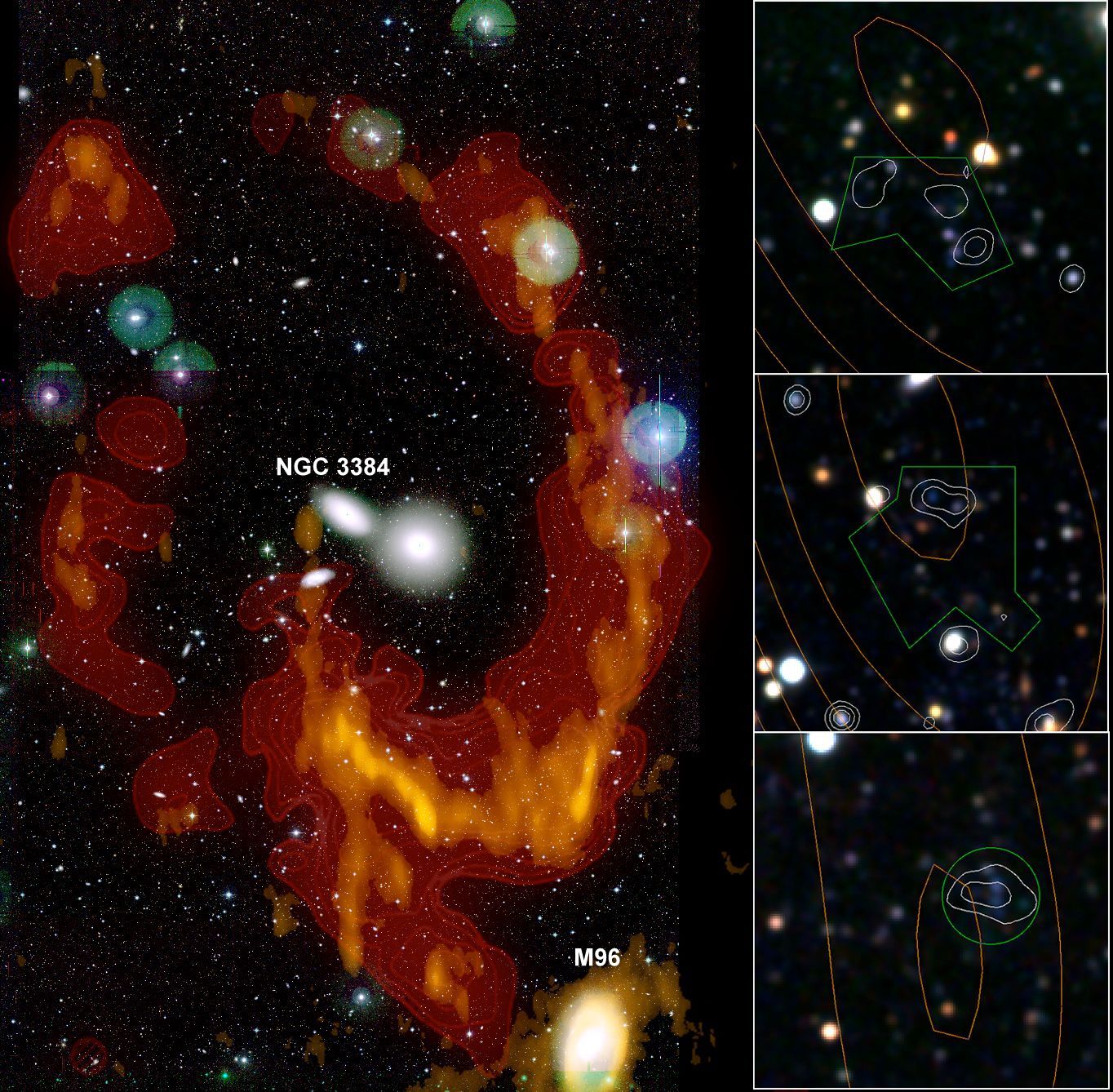
Today's paper announces the discovery of another spectacular ring quite similar to the Leo giant. It's about half the size, but still much larger than Keenan's Ring. It's got about 3 billion solar masses of gas but not much in the way of associated stars. Actually, they point out a few stellar smudges within the structure that could be part of the Ring but it's by no means clear this is actually the case, so it might be completely optically dark. What's especially strange about this one is that the central galaxy is an elliptical, which don't usually have much gas at all.
Like Keenan's Ring, this feature is distinctly offset from the central galaxy - although not nearly as much as in the case of Keenan's. On the other hand, it has a much larger velocity gradient, making a collisional origin somewhat more likely. The lack of any stellar disturbances is a bit odd though.
What could be going on ? Well, in elliptical galaxies which do have gas, it's thought the gas density is much lower than in spiral galaxies. So the authors suggest a collision in those cases would have quite different effects to more spectacular features like the Cartwheel : the compression of the gas just isn't enough for it to reach the densities needed for star formation. Additionally, the shock heating from the compression may be more effective, making most of the gas ionised and unable to form stars. Alternatively, the ring could be the remains of a disrupted gas-rich galaxy that fell into an unpleasant orbit around the elliptical and never escaped.
There's not much more we can say at this stage other than, "wow, a giant ring, cool !". Observations of ionised gas could help trace other components and see if this really was formed by collision, while simulations could show if there's a plausible encounter that really could form a gas ring that leaves the stars so completely undisturbed. We'll just have to wait and see.
Here we report the discovery with the Giant Metrewave Radio Telescope of an extremely large ($\sim$115 kpc in diameter) HI ring off-centered from a massive quenched galaxy, AGC 203001. This ring does not have any bright extended optical counterpart, unlike several other known ring galaxies.
The saga of galaxies without dark matter continues.
At first, I thought the thing sounded pretty cool. Lots of accusations were made that they'd got the distance wrong, which means they'd underestimated the total mass , but most of them didn't seem very credible to me, (granting that I'm no expert in this). But then another claim said that there were two groups in this part of the sky, one close and one more distant. That sounded a lot more believable and would give a good excuse for everyone getting the distances confused.
This latest measurement says nope, these galaxies are far away and don't have any dark matter. They use deeper Hubble data and show that prospect of the galaxies being much closer just don't fit. They say that previous data was too shallow, so that the red giant stars needed for distance measurements (red giants act as a sort of standard candle of known brightness) weren't visible, biasing the result in favour of a lower distance measurement. They don't really comment as to why different authors found different distances from the same data, except perhaps a hint that the calibration of the magnitudes may have been wrong.
Given the recent discovery of a whole population of gas-rich objects without dark matter, for which distance concerns aren't so important as they're quite a bit further away, these original claims should probably be given rather more credibility. There hasn't been much response to those latest detections yet, though it's still early days and the publication was only a letter, not a full article. Of course it's possible the original objects are actually normal objects but the new ones are indeed dark matter deficient, although that would be a bit weird.
The authors say that even deeper Hubble observations are on their way. Will this finally settle the matter ? I somehow doubt it. To my mind, the focus should switch to those gas-rich galaxies without dark matter, which don't have such distance or velocity ambiguities. Perhaps when there's a full paper published people will start to realise that there's a whole other bunch of really interesting objects to work on instead of these two usual suspects.
Previous studies have shown that the large, diffuse galaxies NGC1052-DF2 and NGC1052-DF4 both have populations of unusually luminous globular clusters as well as a very low dark matter content. Here we present newly-obtained deep Hubble Space Telescope (HST) Advanced Camera for Surveys (ACS) imaging of one of these galaxies, NGC1052-DF4.
Time for some more pretty pictures of hydrogen....
It's proving surprisingly difficult to convince people that some streams I've found in the Virgo cluster radio data are real. So to settle the matter once and for all, I've resorted to creating synthetic galaxies and adding fake streams and noise extracted from real data. Then I blindly search the data, labelling what I think looks like a stream and what doesn't. Since I don't know in advance which galaxies have streams or not, this should be a good way to quantify very rigorously how many false positives can occur just due to the noise, as well as measuring how many of the known fake streams would actually be detected by the search technique.
Each of these 100 pillars is a synthetic galaxy, with the vertical axis being velocity. Each of the "segments" is a contour at a different velocity channel, extended into 3D. Real galaxies would look a bit more complicated than this, but these are good enough to search for features as extended as the ones in the real data. Arranging them into a neat grid makes it easy to search the whole data set very quickly and isn't just for the sake of making something minimalist.
You can't really see the fake extensions from this angle - they're more visible from underneath. This particular data set has a stream in every galaxy, always pointing in the same direction. For the real search I vary the length, angle, brightness, presence, and number of velocity channels of the streams.
These pretty pictures aren't going in the paper - for that, I'm showing a boring but more easily comprehensible 2D plot. They look nice though.
Large-scale simulations of the Universe show a characteristic network of filaments and voids, which is in spectacular agreement with real observations of the distribution of galaxies. Even within the voids, what few galaxies are present are distributed in thin tendrils. Galaxies are like flies caught in this cosmic web of dark matter, except fortunately there aren't any giant spiders coming along to eat them, which is a shame because that would inspire some pretty bad-ass mythology.
But what's in between the galaxies, in the filaments themselves ? They appear, as predicted, to have their own dark matter, acting as a sort of scaffold onto which other material can accrete. Detecting this infalling gas would be pretty neat as this could give clues to galaxy formation and survival. For example, the Milky Way is currently forming stars at such a rate that it ought to run out of gas pretty quickly, so unless we happen to be witnessing it in its final phase of star formation, it's likely that it's being re-supplied from somewhere.
Claims for direct detection of the gas in filaments are many and various, the difficulty being that it's hard to distinguish between material present in the primordial filament and stuff that's been chucked out of galaxies during interactions (not to mention that the gas is especially thin and hard to detect at all). There have been a few credible possibilities though, such as this single giant filament seen by Planck, and a convincing statistical detection from stacking observations of many pairs of galaxies. But information is very, very scant.
This paper takes things to a new level with a direct detection of faint UV emission in a complex of very bright, very distant galaxies. Like the earlier Planck observations, the emission is too extended to likely result from galaxy interactions (it's about 1 Mpc across), but unlike Planck it shows several different structures, and looks a lot more web-like.
The detection here was possible only due to an exceptional circumstance. At a redshift of 3, the Universe was only about 2 billion years old, and therefore a lot smaller and denser than it is today. Star formation activity and supermassive black holes were also churning out energy like nobody's business, but this particular target region is exceptional even by the standards of the time : it has a density of active galaxies about 1,000 times greater than the average of the day. Which is slightly insane and terrifying, but does explain how the web can be detected here when it's normally so faint.
Could it be that this is just unusually extended gas from tidal interactions, and not related to the primordial material in the web ? Probably not. Although a few extensions of similar length are known, the gas here doesn't show much variation in velocity, unlike tidal cases. And its velocity dispersion is lower in the filaments than close to the galaxies, which is what you'd expect if it was cool gas accreting onto the dark matter skeleton. So while there are various other previous claims for detecting parts of the web directly, and a couple of good cases of directing it statistically, this seems like a pretty solid claim on being the first direct detection of an actual proper web and not just a mere bridge between a couple of galaxies.
Cosmological simulations predict the Universe contains a network of intergalactic gas filaments, within which galaxies form and evolve. However, the faintness of any emission from these filaments has limited tests of this prediction. We report the detection of rest-frame ultraviolet Lyman-alpha radiation from multiple filaments extending more than one megaparsec between galaxies within the SSA 22 proto-cluster at a redshift of 3.1.
A couple of weeks ago I mentioned a paper that tries to quantify how weird galaxies without dark matter are in the latest, cutting-edge simulations. The properties of galaxies which look like this in reality depend strongly on their distance, so the authors took the nice approach of quantifying how rare such objects are depending on their true distance. If they're close, then their peculiar velocity would be unusual but their dark matter content would be normal; if they're far away, then their velocities would be normal but their dark matter content would be unusually low.
What annoyed me was that they found objects in the simulations matching those criteria, but didn't describe how such objects (lacking dark matter or moving at weirdly high velocities) form in the simulations. If their formation strongly depends on environment, then the global numbers for how rare they are might be woefully misleading. At least one of those authors has a nasty habit of doing that.
The authors in the current paper, however, have indeed gone and found dark matter deficient galaxies (they do not consider the possibility of strong peculiar velocities here) in simulations and looked at them very, very carefully. And it turns out that there is a strong environmental dependence - but it's a bug, not a feature.
You can't simulate the entire visible Universe, and even if you could, you'd still have to make assumptions about its edge. The standard approach is that the boundary conditions are periodic, so that a galaxy which happens to exit* on one side simply re-appears with the same velocity on the other side. And all of the identified "oddball" galaxies without dark matter are found very close to the edge of the simulation.
* Pursued by a bear ?
Given that the near-edge volume in question is a tiny fraction (0.1%) of the whole simulation, that's already a massive red flag. But it's not quite enough to say for sure if this is the cause. For these weirdos share another common feature of experiencing recent mergers. Although galaxy mergers are common events, it's possible that the galaxy-finding algorithms could occasionally get very confused and start misidentifying which particles belong to which galaxy. So the galaxy could only appear to lose mass because its associated dark matter has been wrongly identified.
But that's not the case. When they looked at the oddballs in detail, they found that as they approached the edge of the simulation they slowed to a crawl, and they do indeed lose much of their dark matter. They're still not sure what causes the bug, as plenty of galaxies cross the boundaries without incident, but it appears to be related to the galaxies having unusually dense inner cores where acceleration is high. It's highly unlikely that this bug has caused any other problems - it's only affected a handful of galaxies out of many thousands - but a bug it very much is.
What does this mean for the earlier paper ? Well, if all simulated galaxies without dark matter are actually due to numerical artifacts, then it strengthens their claim that they're incompatible with the standard model. But this is by no means clear : selection criteria may mean the two teams have identified completely different objects. Since the current team's criteria are quite strict, there could still be dark matter deficient galaxies in the simulations which are a feature, not a bug. And it should also be a cautionary note that the simulations are not yet the be-all and end-all of the standard model of cosmology.
We searched for isolated dark matter deprived galaxies within several state-of-the-art hydrodynamical simulations: Illustris, IllustrisTNG, EAGLE, and Horizon-AGN and found a handful of promising objects in all except Horizon-AGN. While our initial goal was to study their properties and evolution, we quickly noticed that all of them were located at the edge of their respective simulation boxes.